

• Публікації
  • Відео
  • Події
  • Оголошення
  • Контакти
  • Про проект
  • ОХОРОНА ЗДОРОВ'Я В ЗОНІ
    ЧОРНОБИЛЯ
    Оздоровчі та екологічні програми, пов'язані з Чорнобильською зоною відчуження.

    Цей проект фінансується ЄВРОПЕЙСКОЮ КОМІСІЄЮ

    This project is financed by the EUROPEAN COMMISSION

    • Укр
    • Eng
    • Fra

    ПАТОЛОГІЧНІ ТА АДАПТАЦІЙНІ ПРОЦЕСИ В ОРГАНІЗМІ ДІТЕЙ ПІСЛЯ АВАРІЇ НА ЧОРНОБИЛЬСЬКІЙ АТОМНІЙ ЕЛЕКТРОСТАНЦІЇ

    Бандажевський Ю. І., Дубова Н. Ф.

    Координаційний аналітичний центр «Екологія і здоров’я», Україна (Київ 2026)

    Дослідження, проведені нами протягом багатьох десятиліть, дозволяють зробити низку важливих висновків щодо радіаційного впливу на людську популяцію після аварії на Чорнобильській атомній електростанції (ЧАЕС).

    Аварія на ЧАЕС призвела до викиду у навколишнє середовище величезної кількості радіоактивних елементів, у якому переважав 137Cs. Цей радіонуклід розпадається з виділенням гама- і бета-випромінювання, з утворенням, стабільного 137Ва.

    В організм жителів постраждалих територій 137Cs надходив і в даний час надходить, переважно ентеральним шляхом, з їжею тваринного та рослинного походження.

    У СРСР, а також у ряді незалежних держав, що утворилися в результаті його розпаду, на законодавчому рівні були встановлені допустимі рівні вмісту 137Cs та 90Sr у продуктах харчування.

    Підставою для створення таких документів була економічна доцільність, заснована на існуванні в різні роки після Чорнобильської аварії, сільськогосподарської продукції з певним вмістом 137Cs і 90Sr.

    У міру того, як питома активність цих радіонуклідів у продуктах харчування знижувалася, посилювалися нормативні вимоги. Однак це не виключало постійного надходження в організм людей радіоактивних елементів.

    Таким чином, на законодавчому рівні допускалося проникнення в організм ентеральним шляхом значної кількості 137Cs та 90Sr.

    При цьому не було визначено впливу цих радіонуклідів на стан здоров'я дітей та дорослих.

    Радіаційному опроміненню жителів постраждалих територій сприяють лісові пожежі в Чорнобильській зоні відчуження (ЧЗВ), а також використання в побуті деревини, що містить радіоактивні елементи

    Протягом багатьох десятиліть мільйони людей жили та живуть в умовах постійного радіаційного впливу.

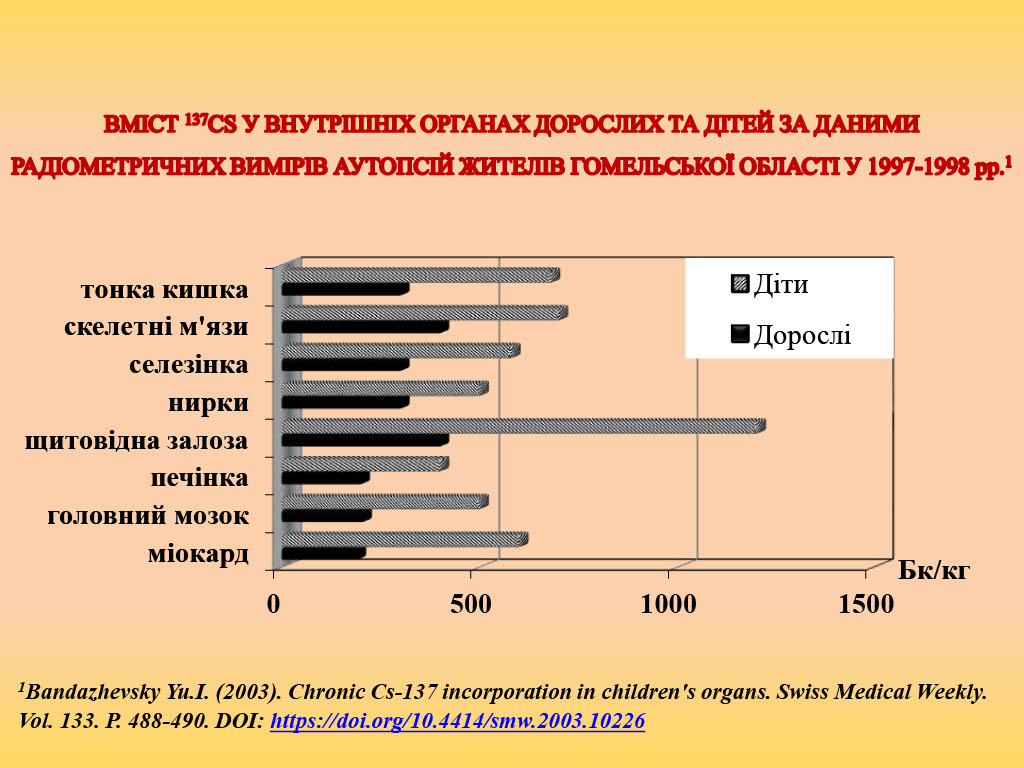
    В перше десятиліття після аварії на ЧАЕС надходження 137Cs до організму дітей та дорослих було значним, що дозволило визначити інкорпорацію цього радіонукліду в окремі внутрішні органи.

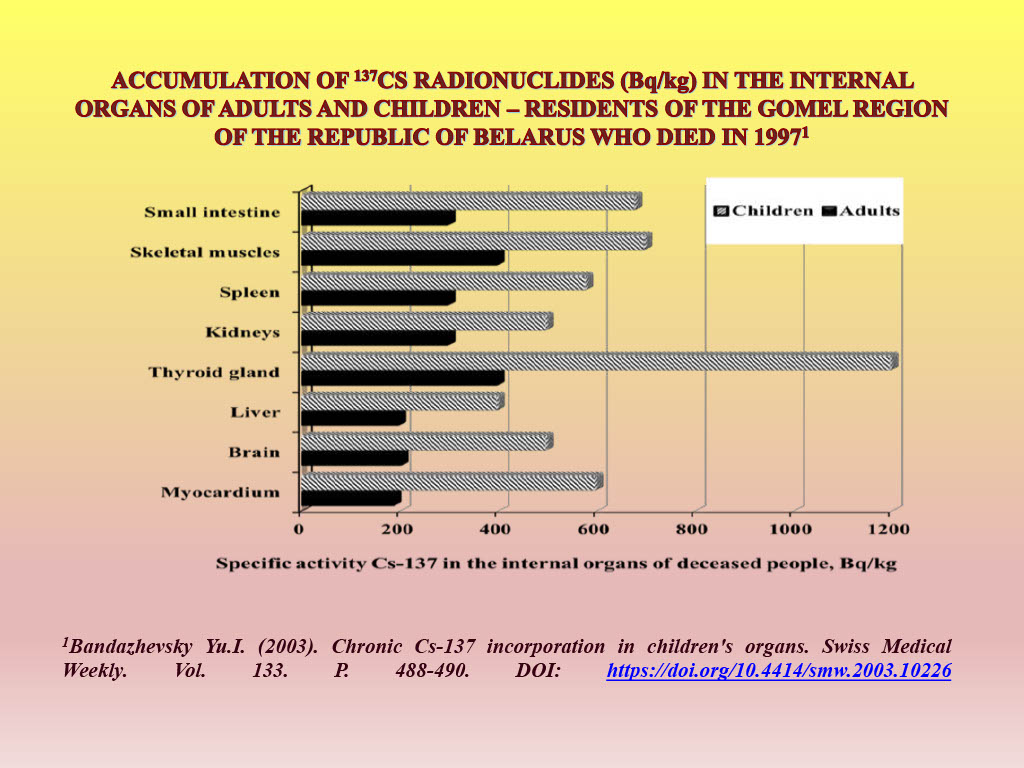
    Всупереч думці, що склалася раніше, нами було встановлено те, що 137Cs інтенсивно інкорпорується щитовидною і підшлунковою залозами, печінкою, нирками, серцевим м'язом, а також головним мозком [1] (слайд 2).
    слайд 2
    Слайд 2

    Для того, щоб оцінити вплив радіонуклідів 137Cs на метаболічні процеси в організмі жителів постраждалих територій, нами були проведені численні клінічні, інструментальні, патоморфологічні та біохімічні дослідження дитячого та дорослого контингентів, а також були проведені експерименти на лабораторних тваринах.

    У ході виконаних досліджень оцінювалися структурні та метаболічні зміни в життєво важливих органах, при різній питомій активності 137Cs в організмі.

    Одночасне проникнення 137Cs у тканину серця, печінки, нирок, щитовидної залози та інших внутрішніх органів, викликало пошкодження їх клітинних структур із формуванням синдрому інкорпорованих довгоживучих радіонуклідів (СІДР) [2]. В основі патологічних процесів, що формуються, лежить пошкодження мітохондрій і порушення клітинної енергетики

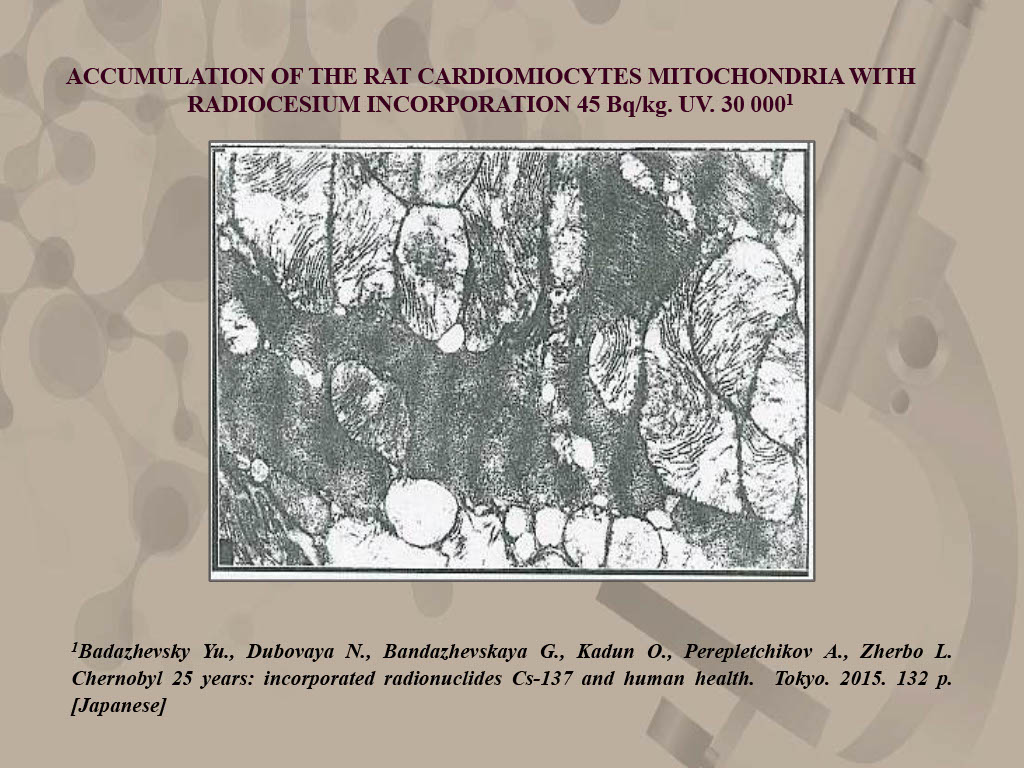
    При питомій активності 137Cs в організмі 30-50 Бк/кг, у клітинах міокарду, при ультрамікроскопічному дослідженні, було зареєстровано збільшення розмірів мітохондрій та їх злиття, що свідчило не лише про пошкодження, а й про розвиток репаративних процесів [2] (слайд 3).
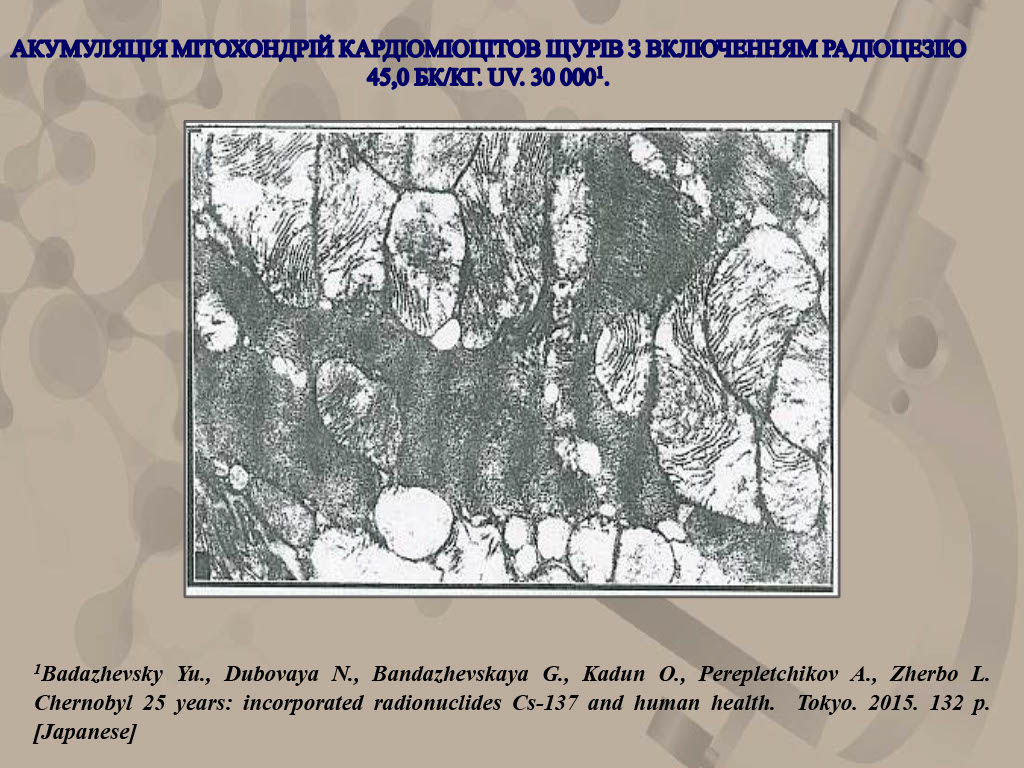
    слайд 3
    Слайд 3

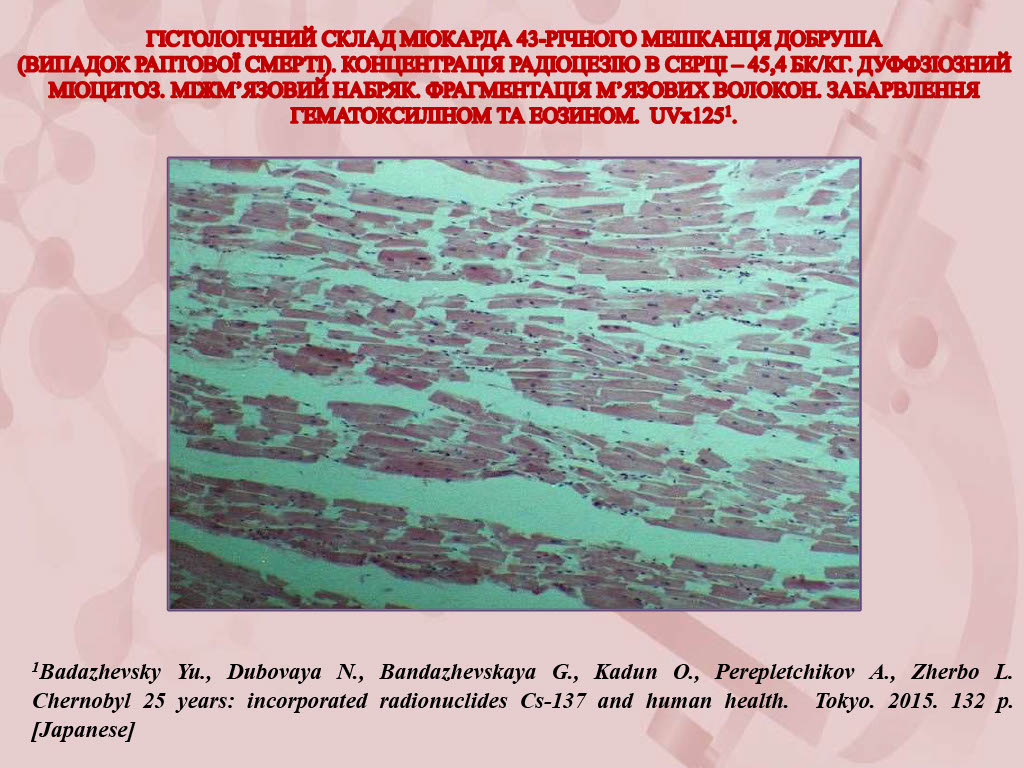
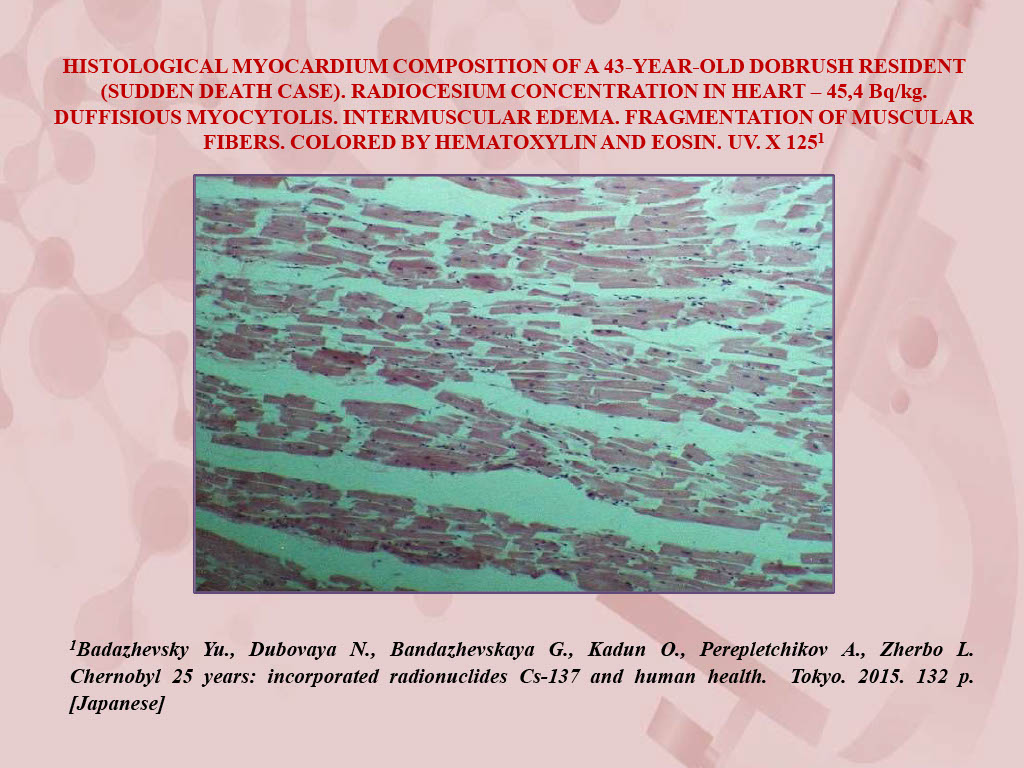
    При цьому в тканині міокарда виникали виражені структурні зміни, які можуть бути причиною смерті [2] (слайд 4).

    слайд 4
    Слайд 4

    У ході досліджень, проведених в Україні у 2013-2017 роках у рамках проектів Європейської Комісії та Регіональної ради Рон-Альп (Франція), у групі дітей, які мешкають поблизу Чорнобильської зони відчуження (ЧЗВ), пошкодження мітохондрій кардіоміоцитів було виявлено у 37,5% [3].

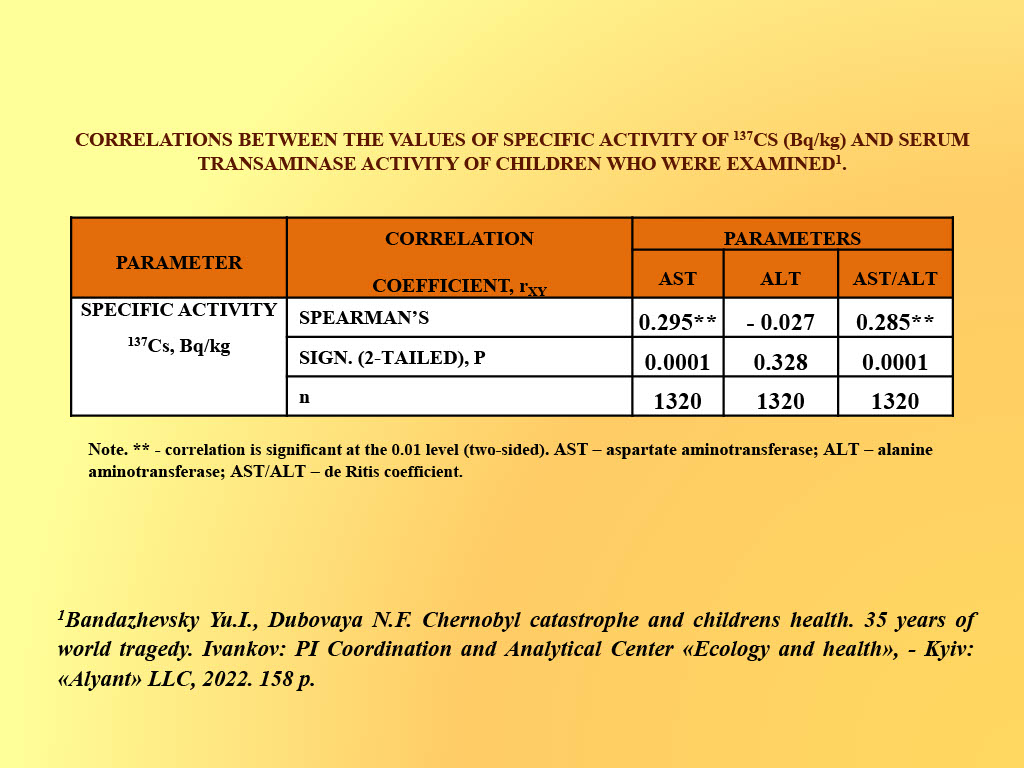
    У цих дослідженнях оцінка пошкодження мітохондрій кардіоміоцитів дітей здійснювалася за результатами визначення активності сироваткових трансаміназ – аспартатамінотрансферази (АСТ) та аланінамінотрансферази (АЛТ).

    Негативний вплив інкорпорованих радіонуклідів 137Cs на мітохондрії кардіоміоцитів обстежених дітей відображає пряма залежність між значеннями питомої активності 137Cs та показниками сироваткової АСТ [3] (слайд 5).
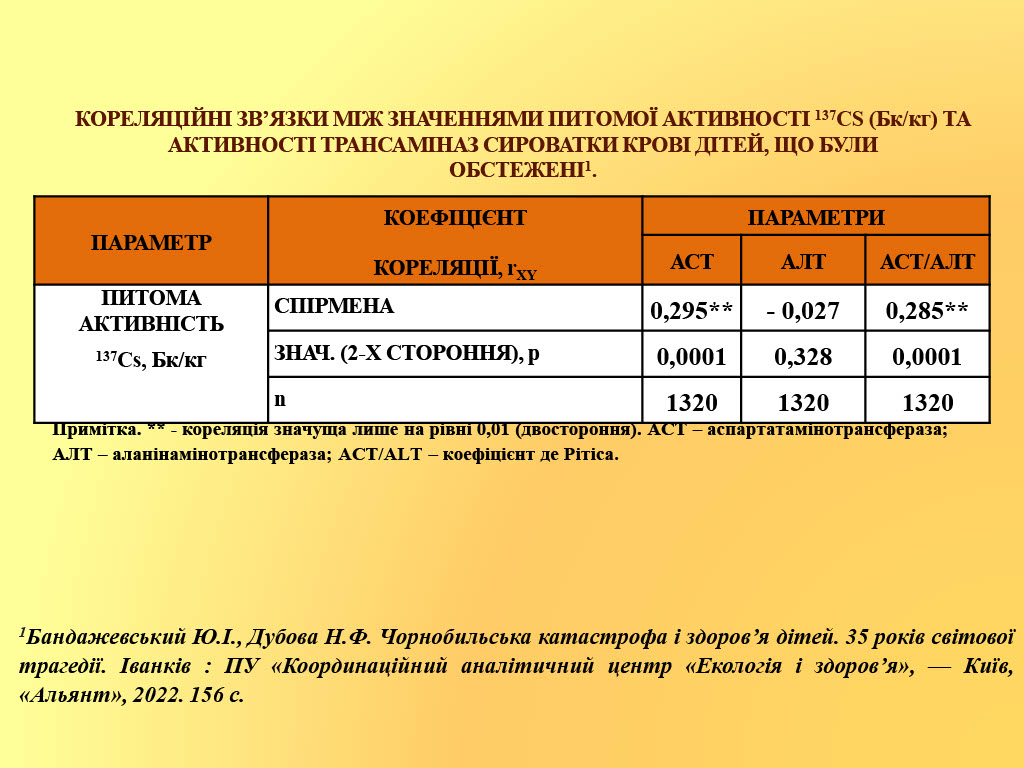
    слайд 5
    Слайд 5

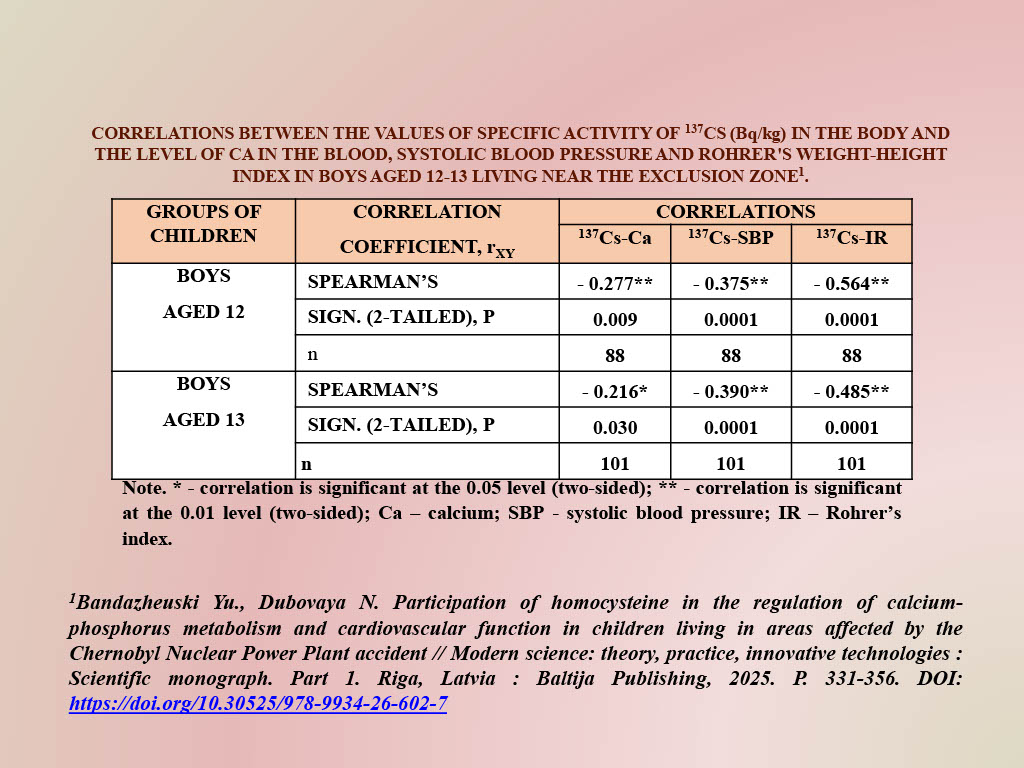
    Зворотний кореляційний зв'язок між питомою активністю 137Cs в організмі та концентрацією сироваткового кальцію [4] (слайд 6) відображає енергетичний дефіцит, зумовлений порушенням функціонування мітохондрій, що сприяє порушенню іонного складу всередині клітин провідної системи серця та виникненню аритмій.

    Зниження, під впливом інкорпорованих радіонуклідів 137Cs, енергетичних можливостей кардіоміоцитів спричиняє зменшення скорочувальної здатності серцевого м'яза, що призводить до зниження артеріального тиску та зменшення кровопостачання органів та систем [4] (слайд 6). Наслідком є порушення фізичного розвитку дитини.

    Негативний вплив інкорпорованого 137Cs на анаболічні процеси в дитячому організмі, що розвивається, відображає зворотний кореляційний зв'язок між питомою активністю даного радіонукліду в організмі і значеннями індексу Рорера [4] (слайд 6).
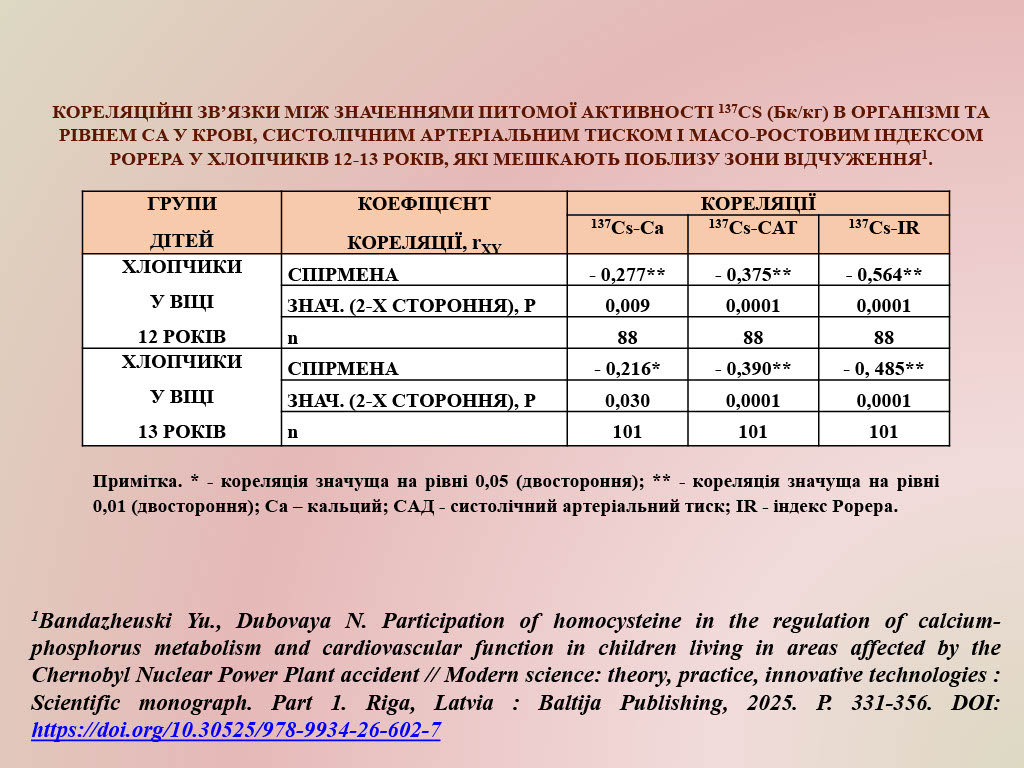
    слайд 6
    Слайд 6

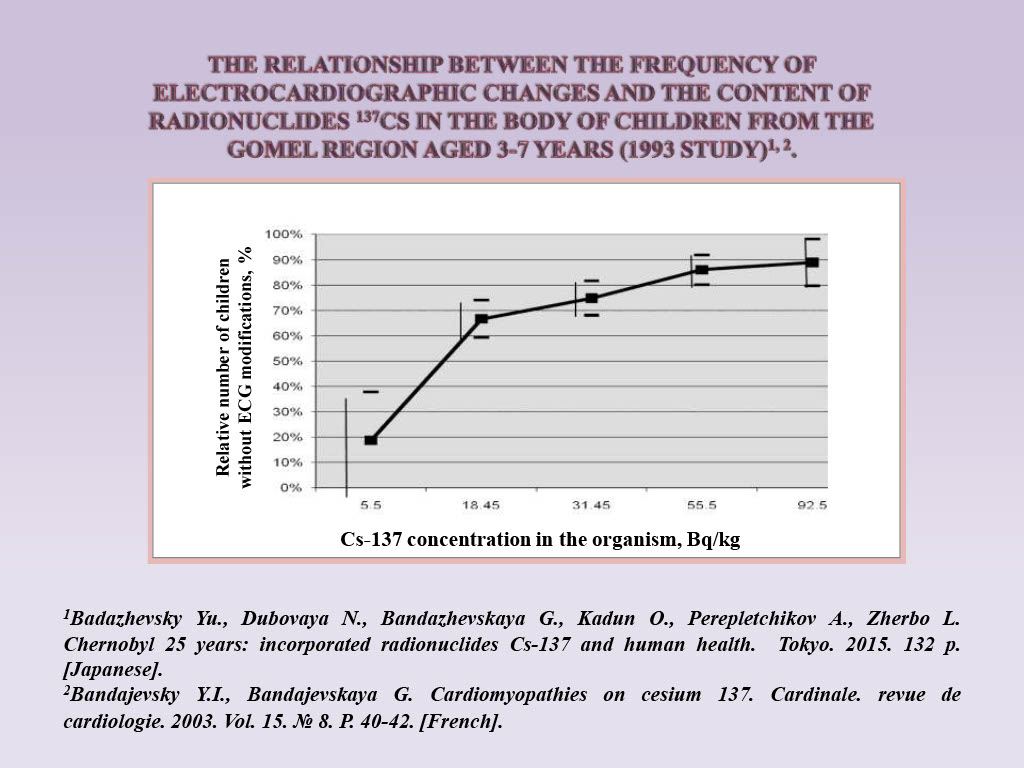
    В перше десятиліття після аварії на ЧАЕС, у групі дітей, які проживають на постраждалій території, була виявлена пряма залежність між частотою електрокардіографічних змін, представлених переважно неповною блокадою правої ніжки пучка Гіса, та питомою активністю 137Cs в організмі [2, 5] (слайд 7).
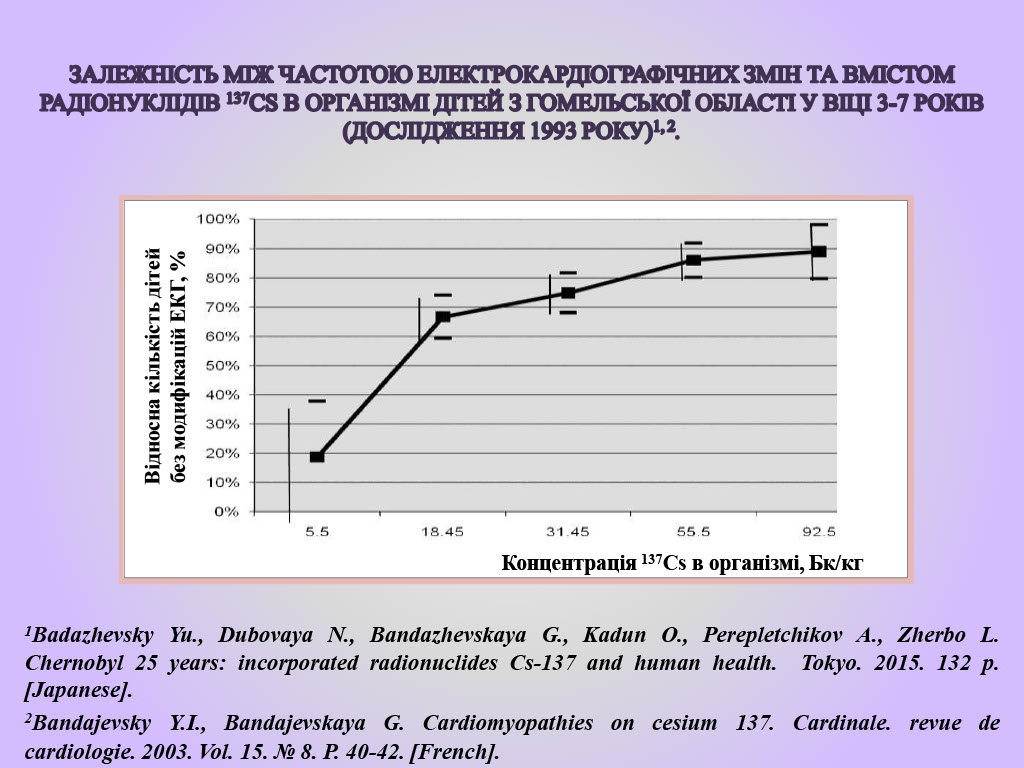
    слайд 7
    Слайд 7

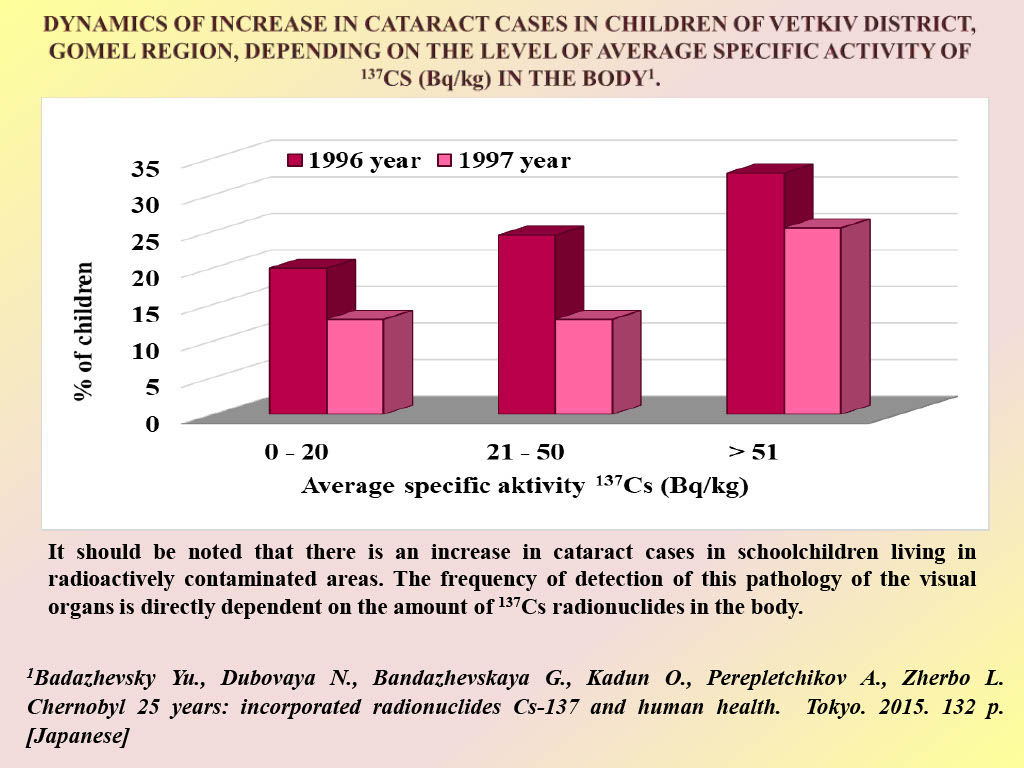
    Аналогічна залежність була виявлена і при виникненні катаракт у дітей, які мешкають на території із щільністю забруднення ґрунтів 137Cs 5-15 Кі/км2і 15-40 Кі/км2 [2] (слайд 8).
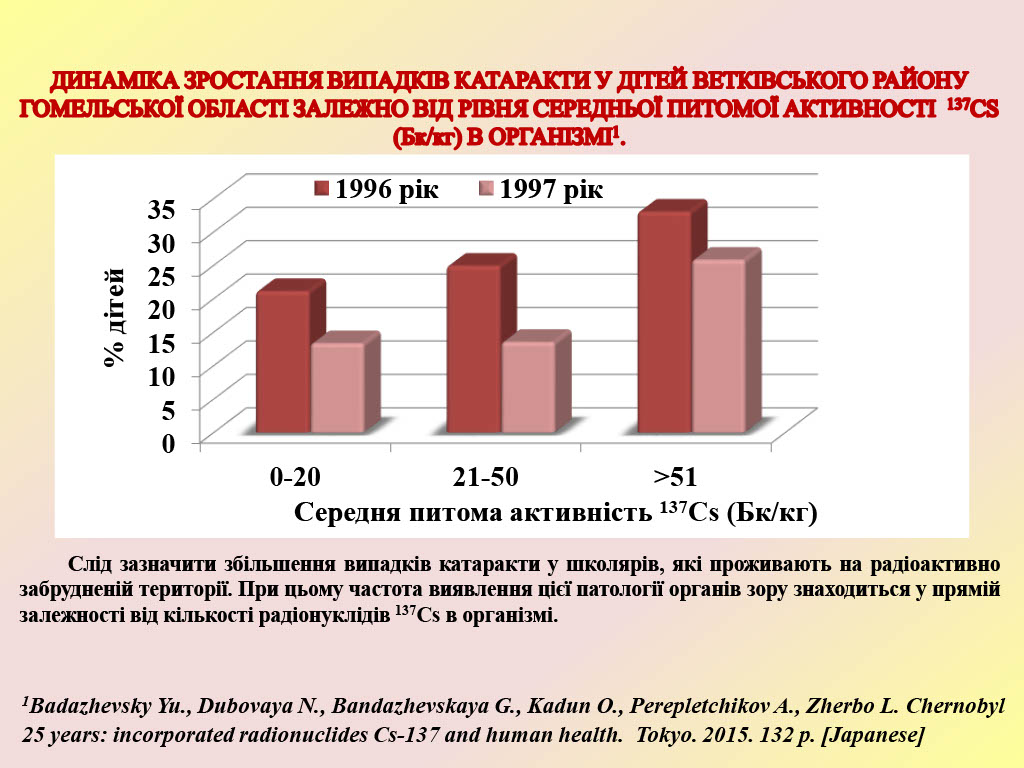
    слайд 8
    Слайд 8

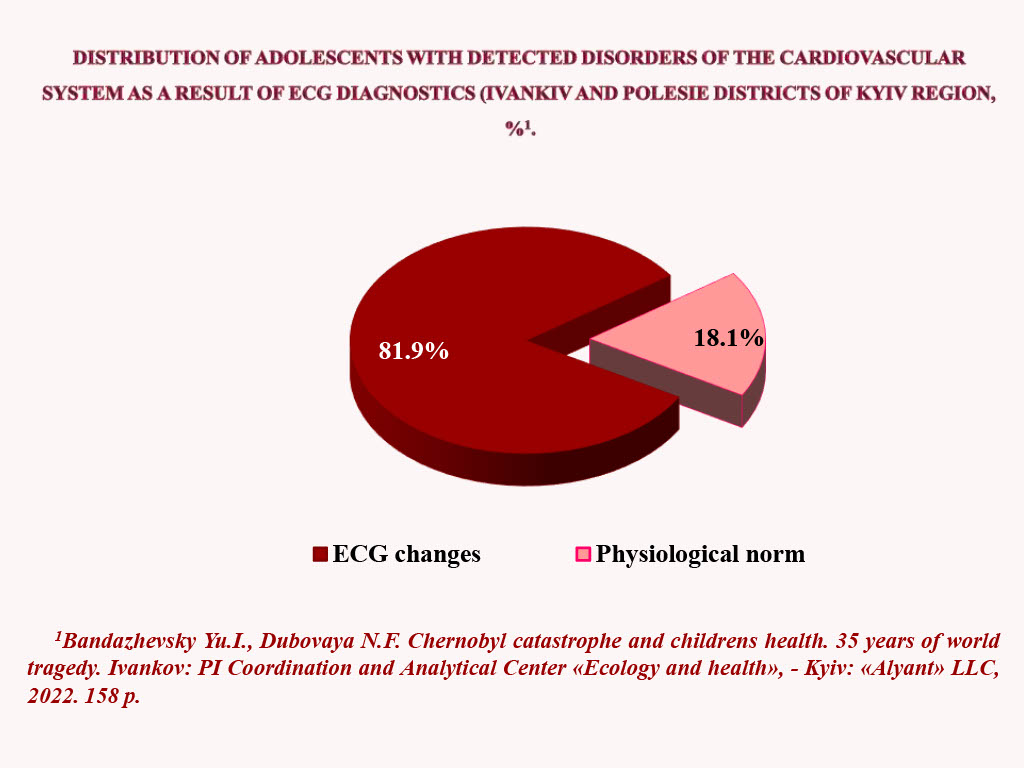
    Порушення ритму серцевих скорочень визначалося й у більшості дітей другого чорнобильського покоління, які мешкають поблизу ЧЗВ [3] (слайд 9). Однак, питома активність 137Cs в організмі дітей була значно меншою, ніж у дітей, обстежених у перше десятиліття після аварії на ЧАЕС [6].
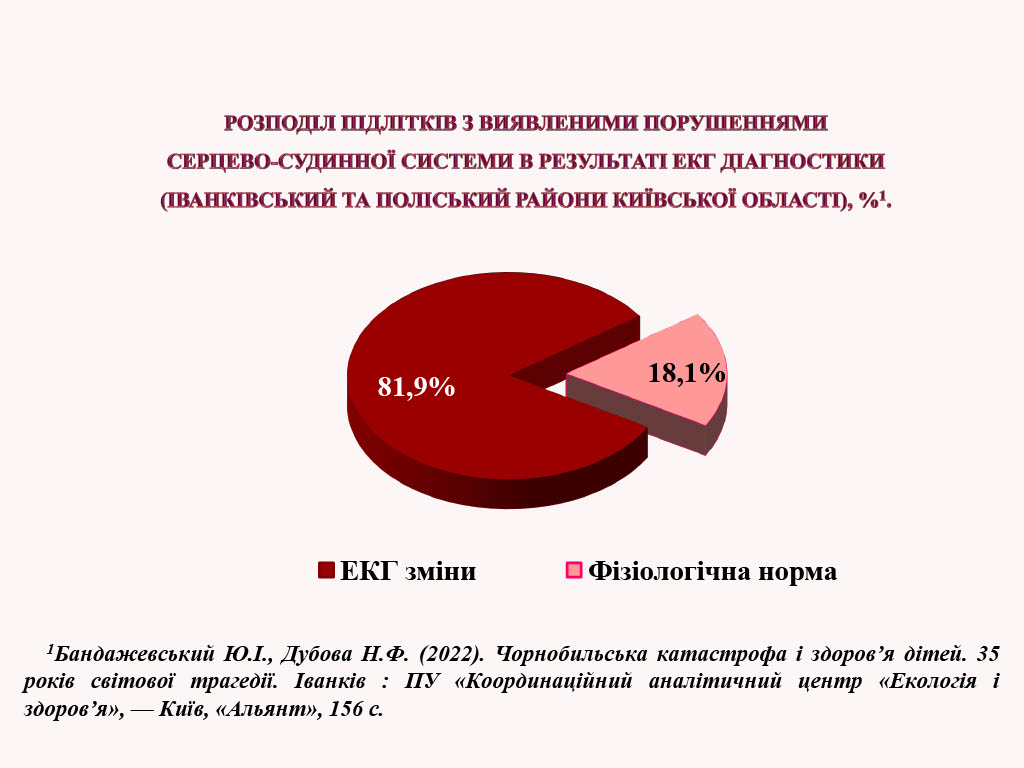
    слайд9
    Слайд 9

    Мітохондріальна дисфункція у дітей, які проживають поблизу ЧЗВ, у віддалений період аварії на ЧАЕС, що виникла під впливом інкорпорованого 137Cs, стала однією з основних причин порушення адаптаційних процесів та зниження резервних можливостей серцево-судинної системи.
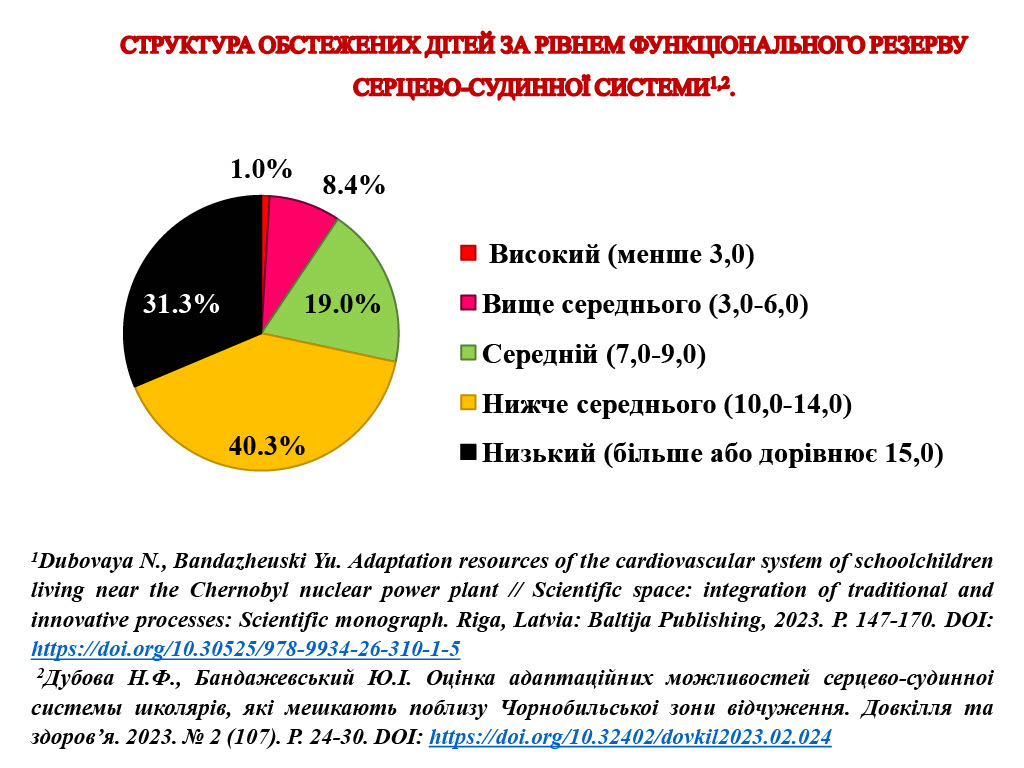
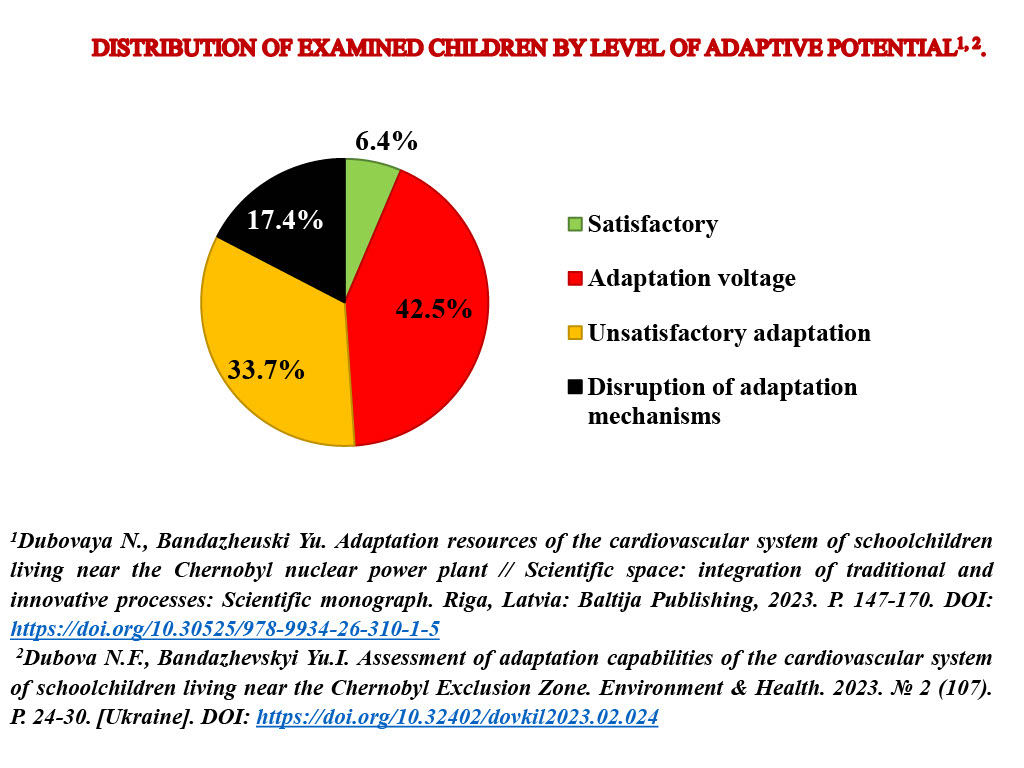
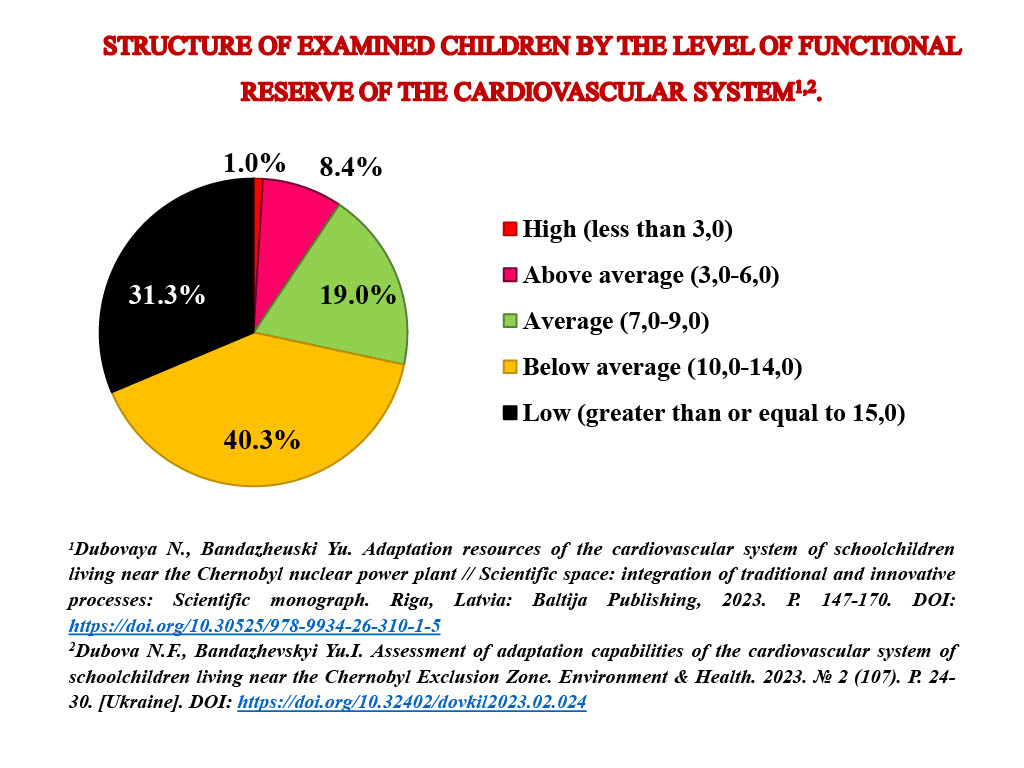
    Незадовільна адаптація та зрив механізмів адаптації реєструвалася у 50% випадків [7, 8] (слайд 10), рівень функціонального резерву серцево-судинної системи нижчий від середнього визначався у 40,3% випадків, а низький рівень у 31,3% випадків [7, 8] (слайд 11).
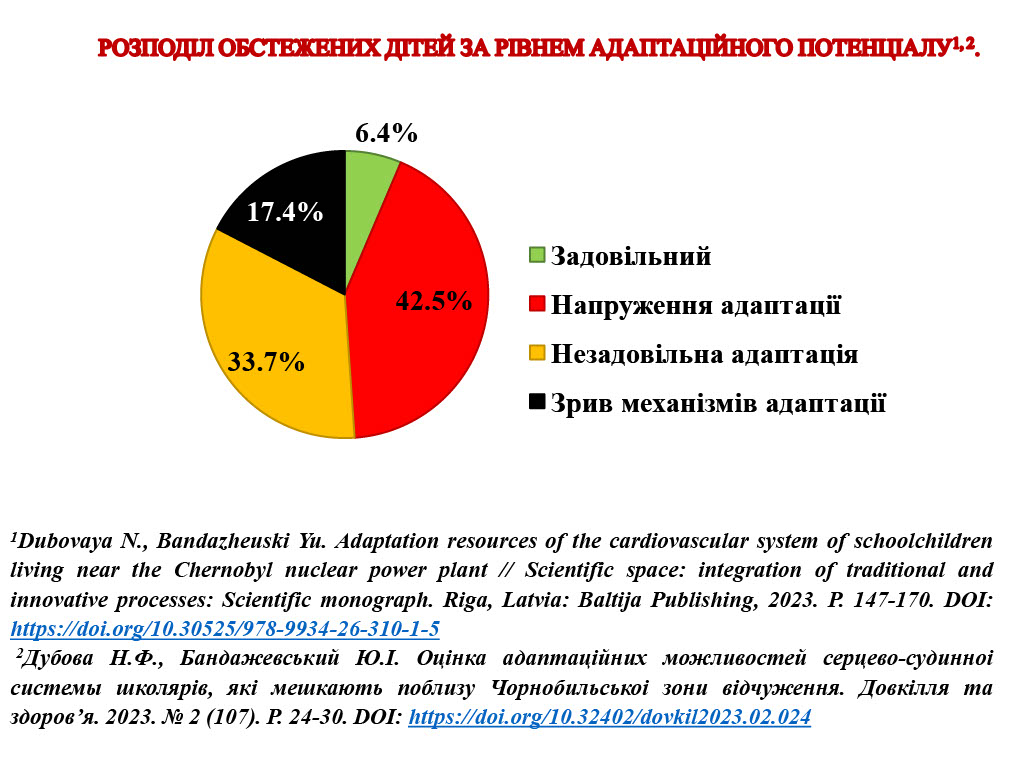
    слайд 10
    Слайд 10

    слайд 11
    Слайд 11

    Патологічні зміни у нирках є причиною порушення обміну речовин в організмі.

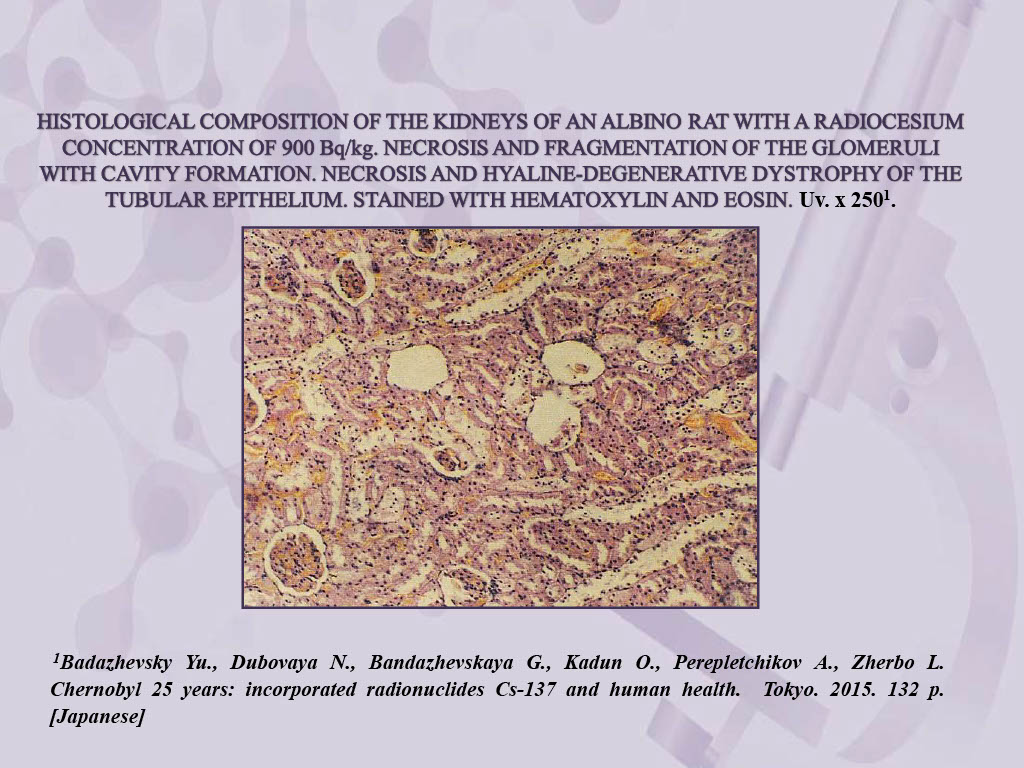
    Нирки є органом, який виводить 137Cs з організму. Найбільш виражені патологічні зміни були виявлені у гломерулярному апараті. Найчастіше реєструвалася прогресуюча деструкція клубочкових структур, до повного зникнення - феномен "танучої крижинки" [2] (слайд 12).
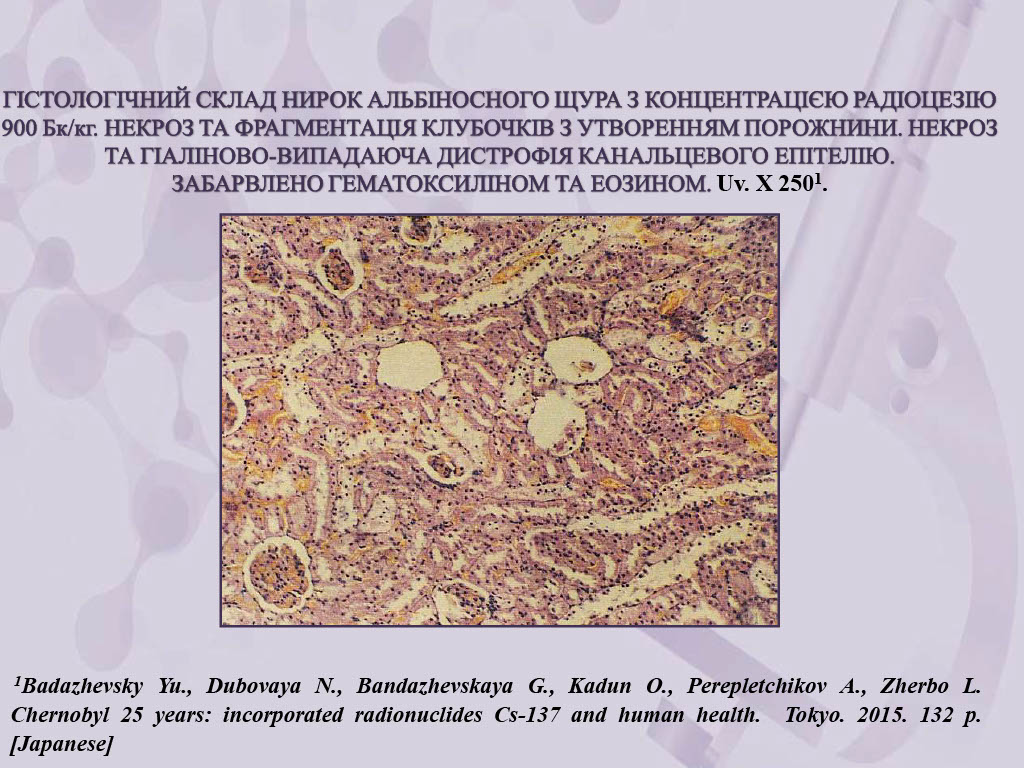
    слайд 12
    Слайд 12

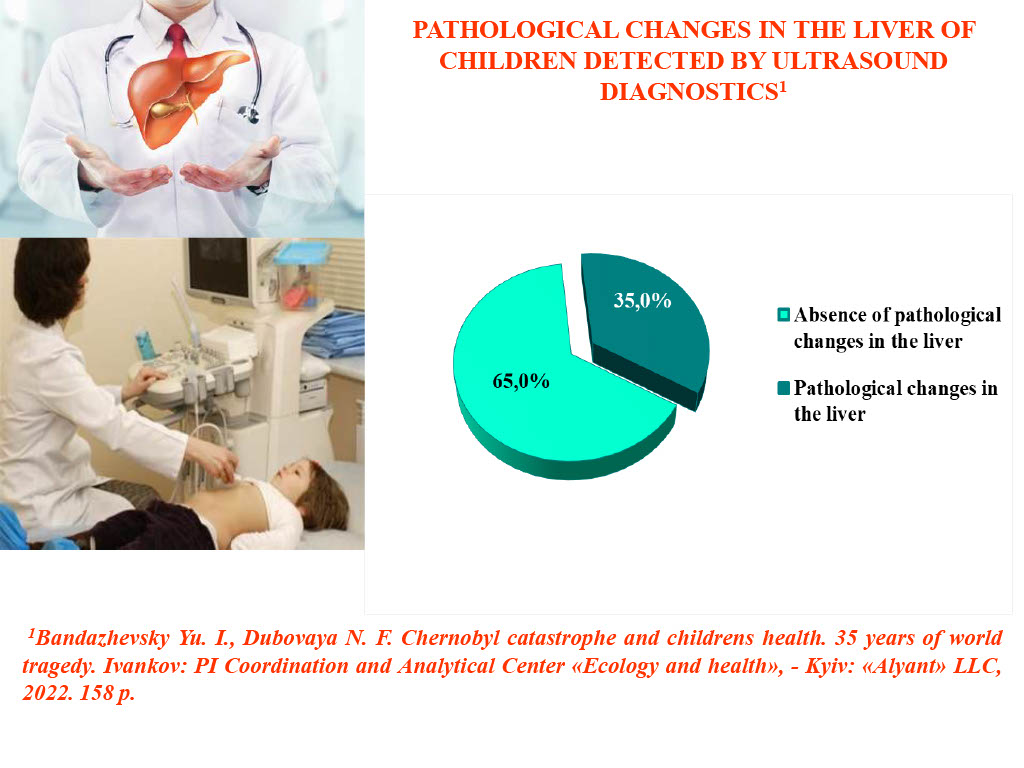
    Результати ультразвукового дослідження свідчать про серйозні структурні зміни в печінці та порушення обміну речовин у 35,0% дітей, які проживають поблизу ЧЗВ [3] (слайд 13)
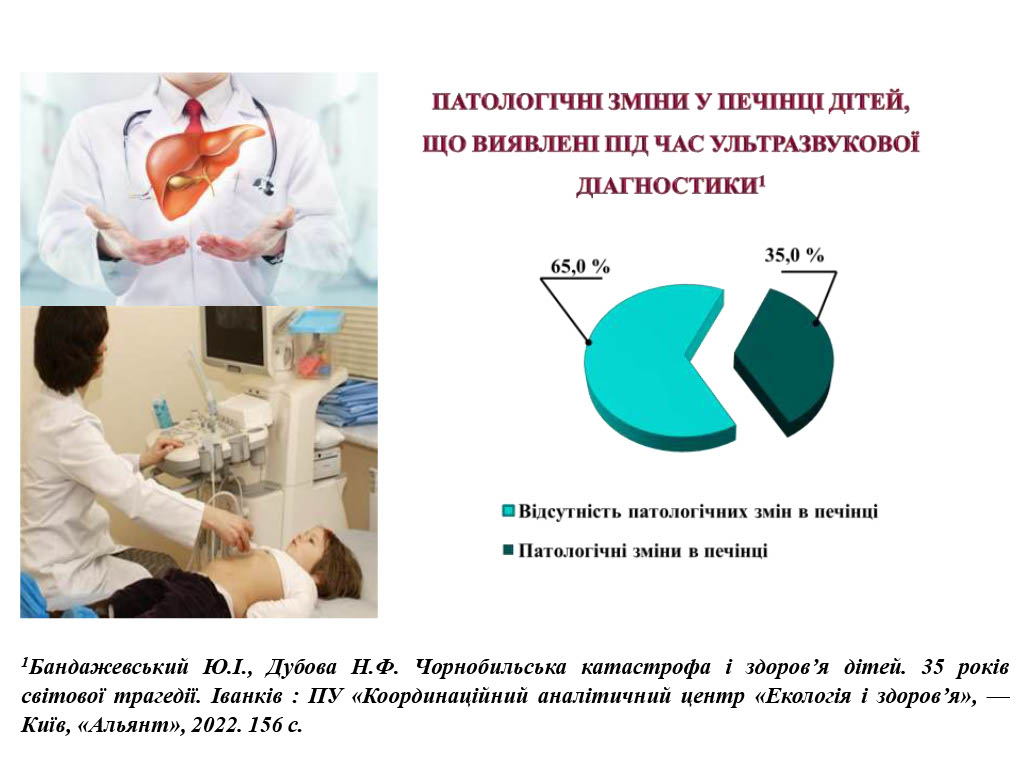
    слайд 13
    Слайд 13

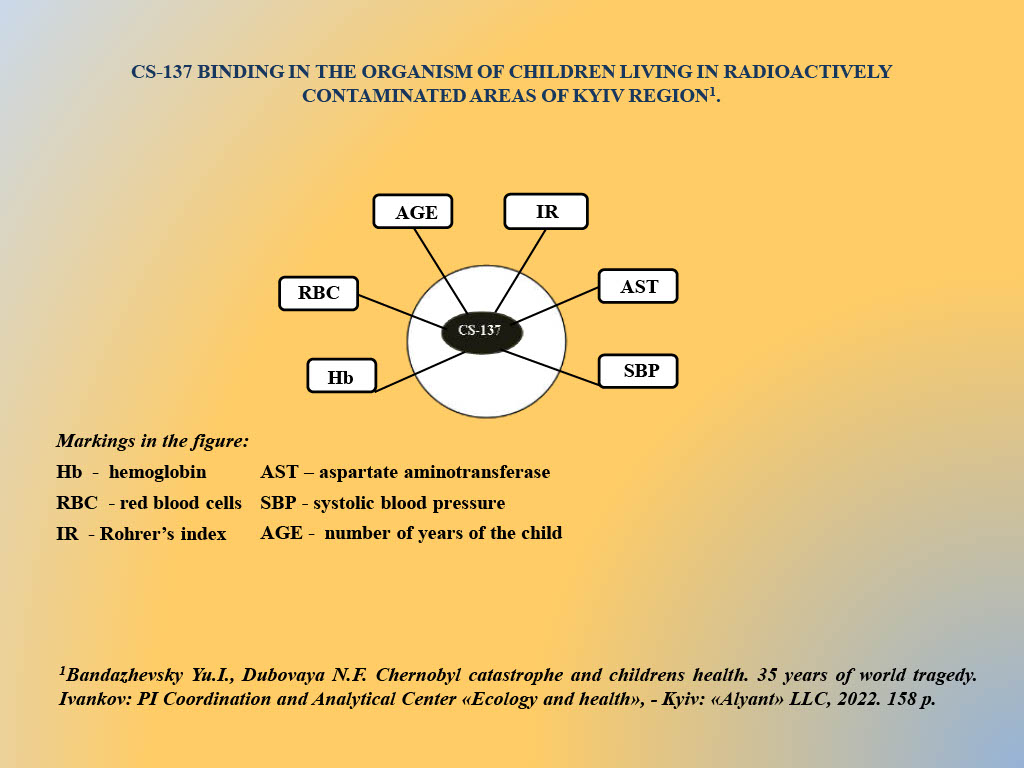
    Проведені дослідження виявили прямий кореляційний зв'язок між питомою активністю 137Cs в організмі та показниками, що відображають життєво важливі функції дитячого організму [3] (слайд 14).
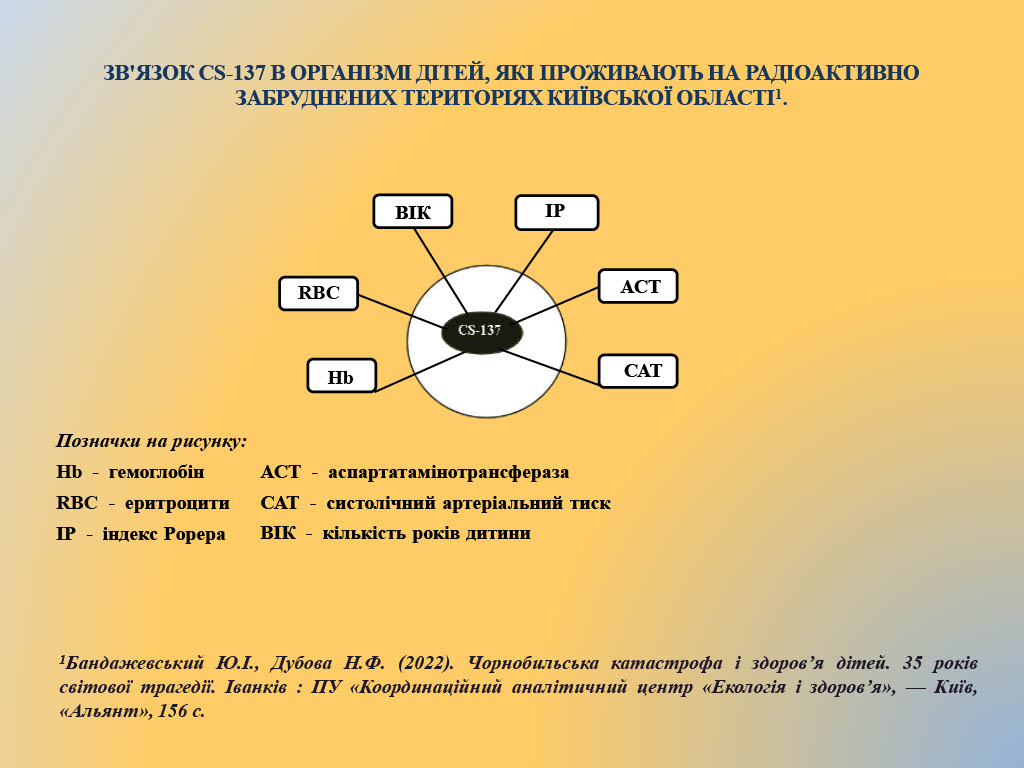
    слайд 14
    Слайд 14

    В умовах енергетичного дефіциту, пов'язаного з інкорпорацією в організм 137Cs, у великої кількості дітей реєструвався стан гіпергомоцистеїнемії - підвищений рівень крові амінокислоти гомоцистеїну

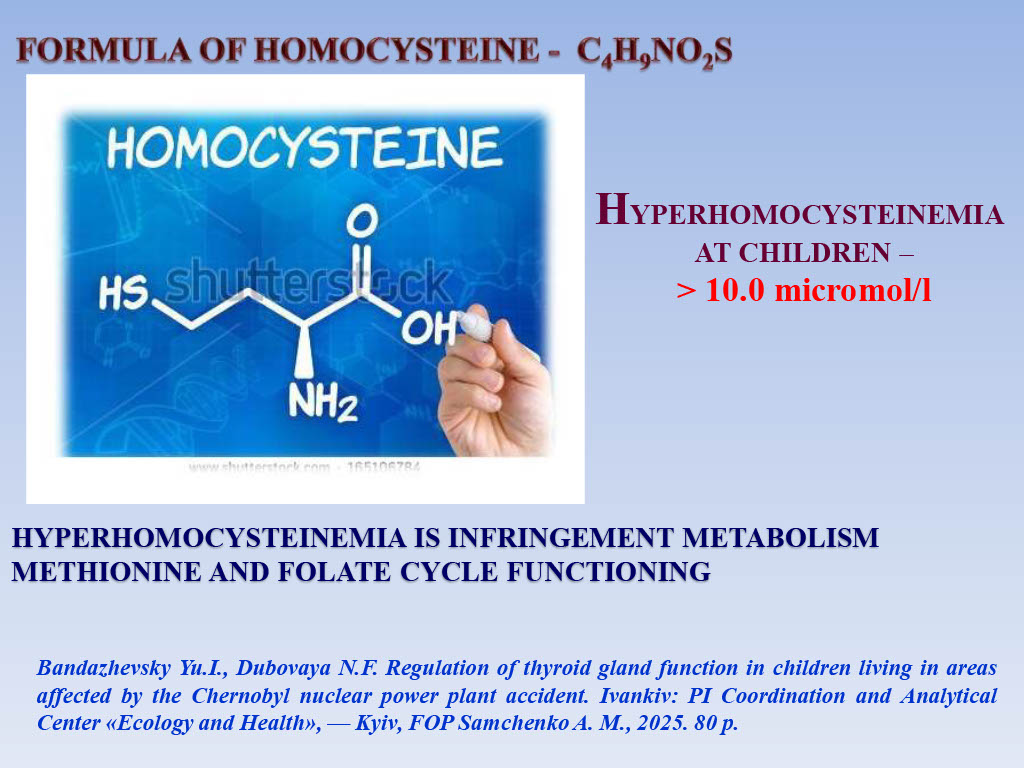
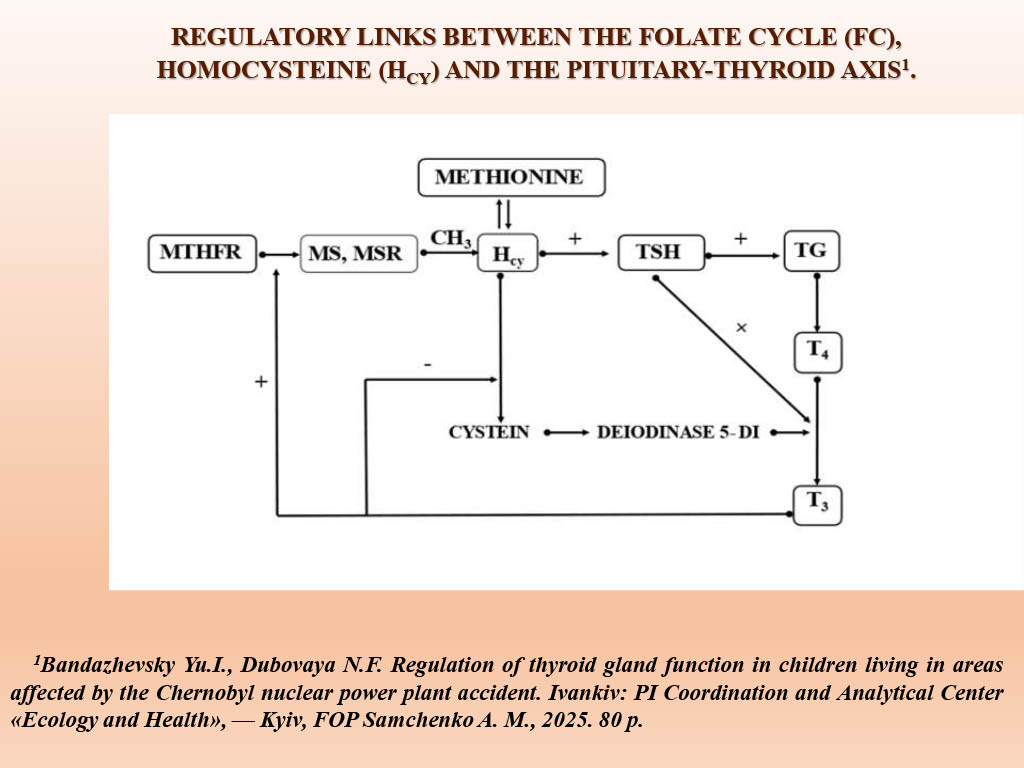
    Гомоцистеїн - сірковмісна амінокислота, є проміжною ланкою в метаболічних циклах незамінної амінокислоти метіоніну, яка є для організму джерелом метильної групи [9] (слайд 15).
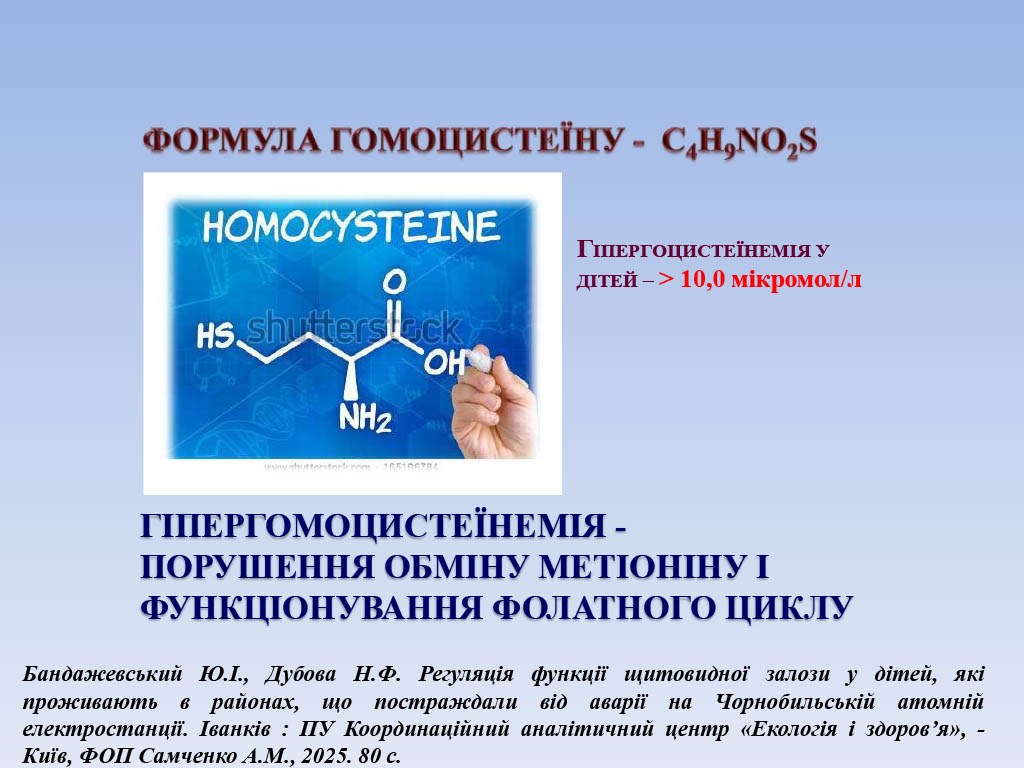
    слайд 15
    Слайд 15

    Рівень гомоцистеїну в крові відображає ефективність процесів метилювання нуклеїнових кислот та білкових молекул.

    Збільшення концентрації гомоцистеїну в крові свідчить про порушення його метилювання та зменшення утворення внутрішнього метіоніну.

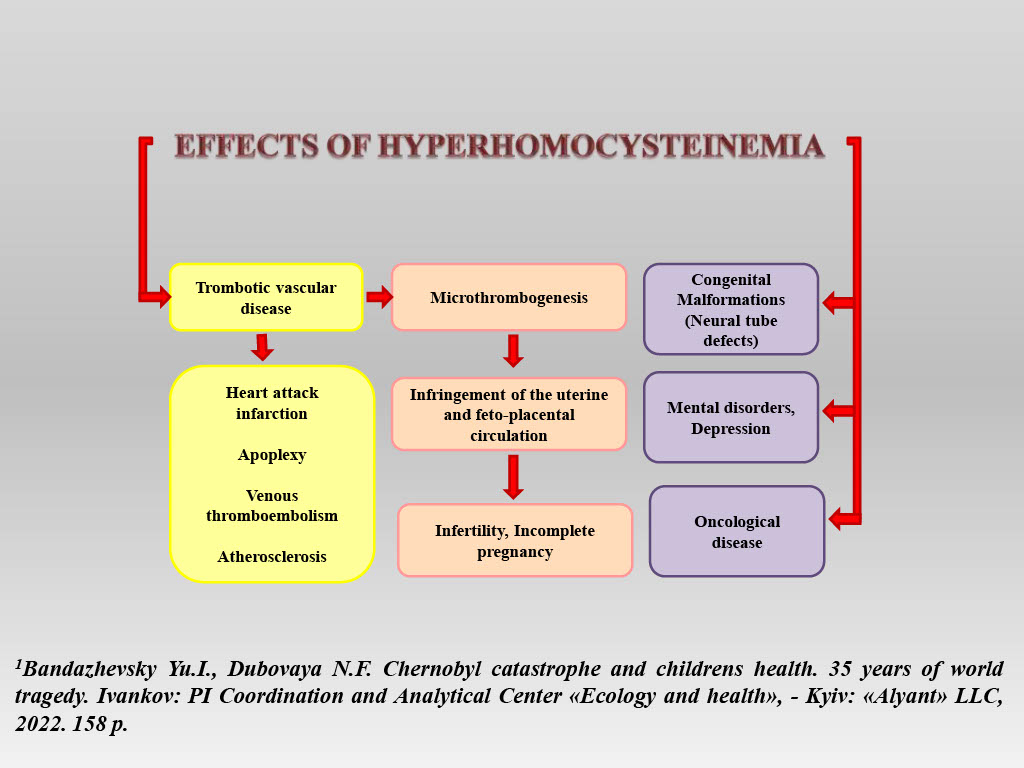
    У дорослих осіб гіпергомоцистеїнемія асоціюється з низкою тяжких захворювань серцево-судинної системи, онкологічними процесами, патологією центральної нервової системи [3] (слайд 16).
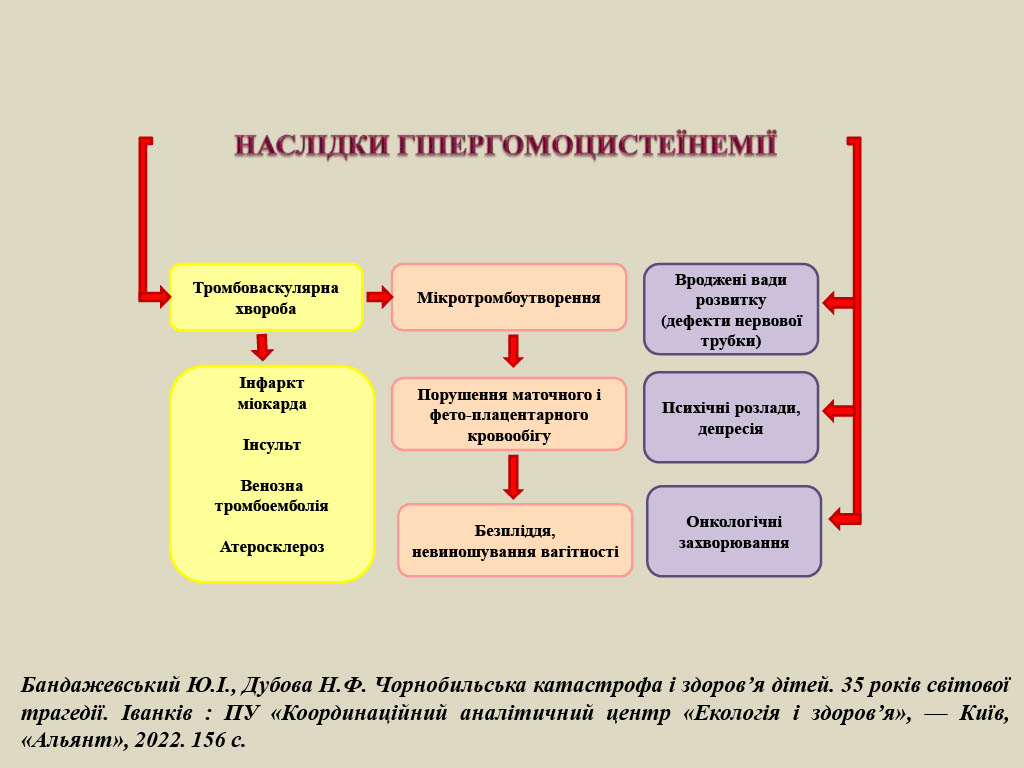
    слайд 16
    Слайд 16

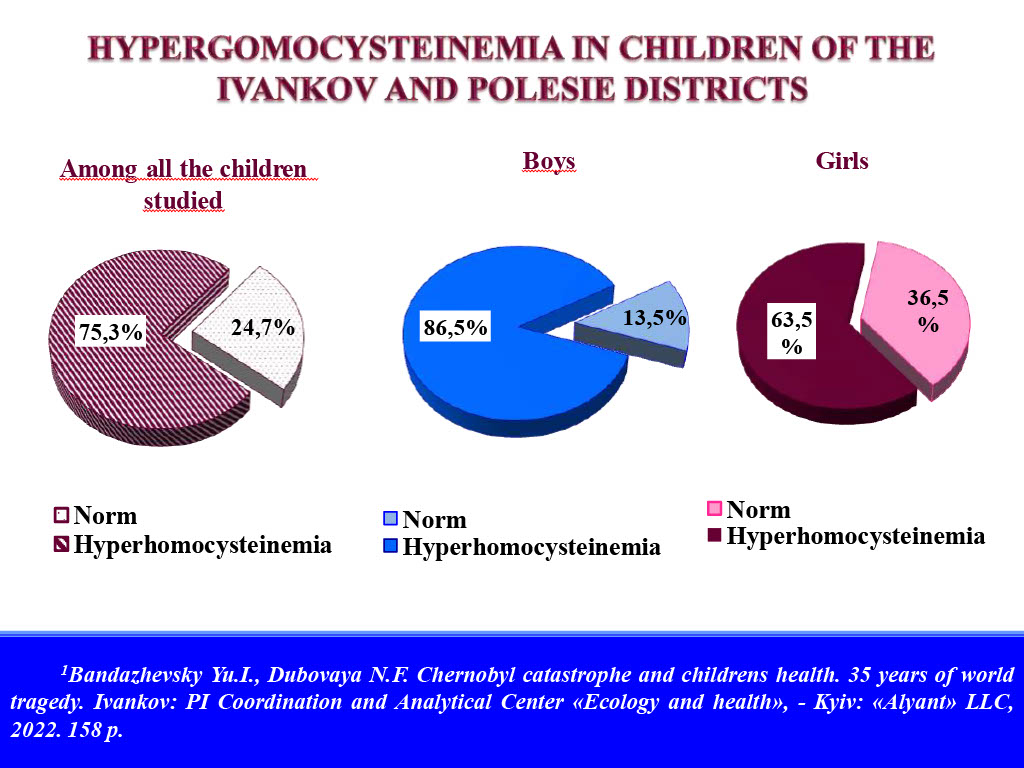
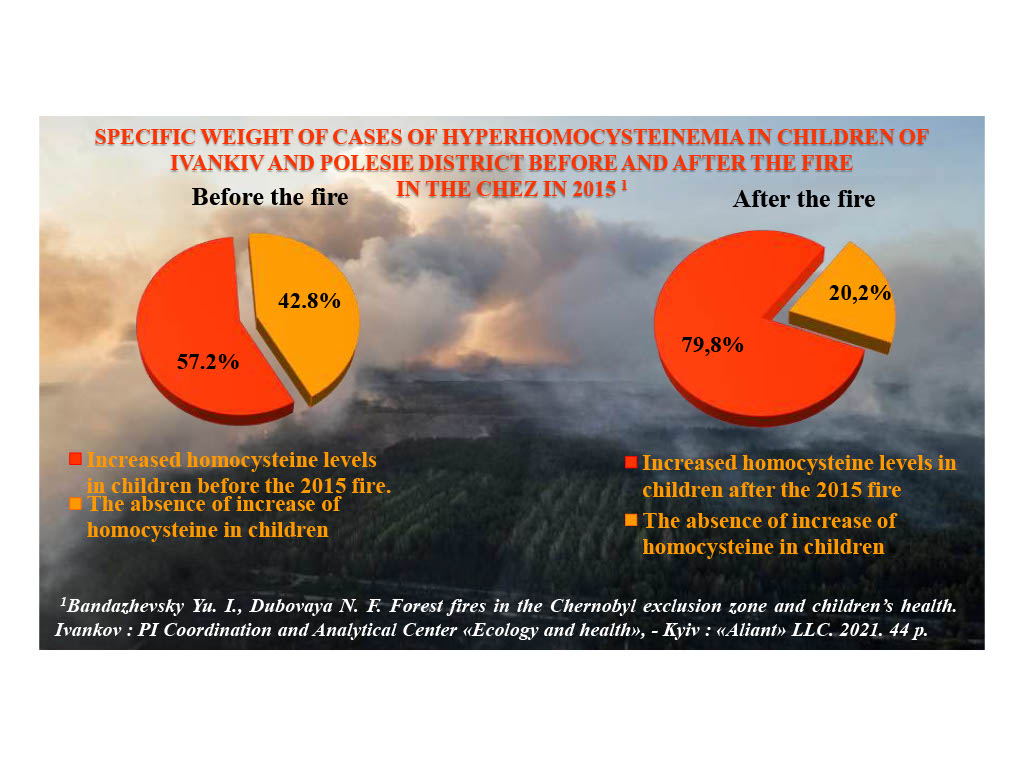
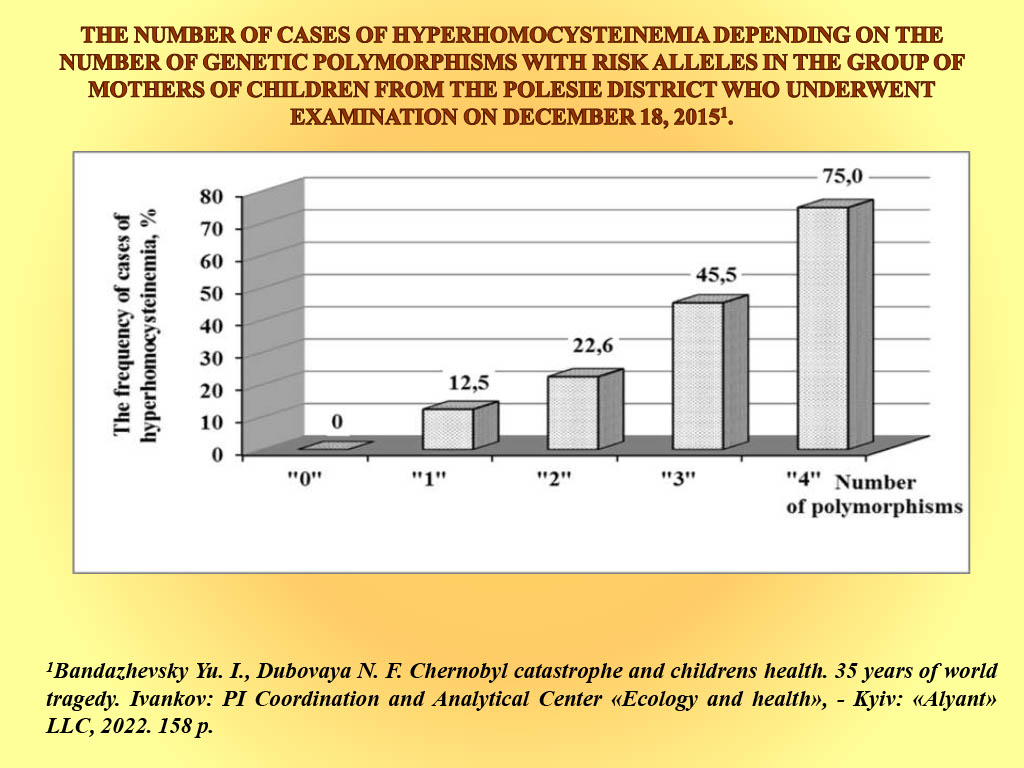
    У ході реалізації проектів Європейської Комісії та Регіональної ради Рон-Альп у 2015 році було вперше виявлено гіпергомоцистеїнемію у великої кількості дітей, які проживають поблизу ЧЗВ [3] (слайд 17).
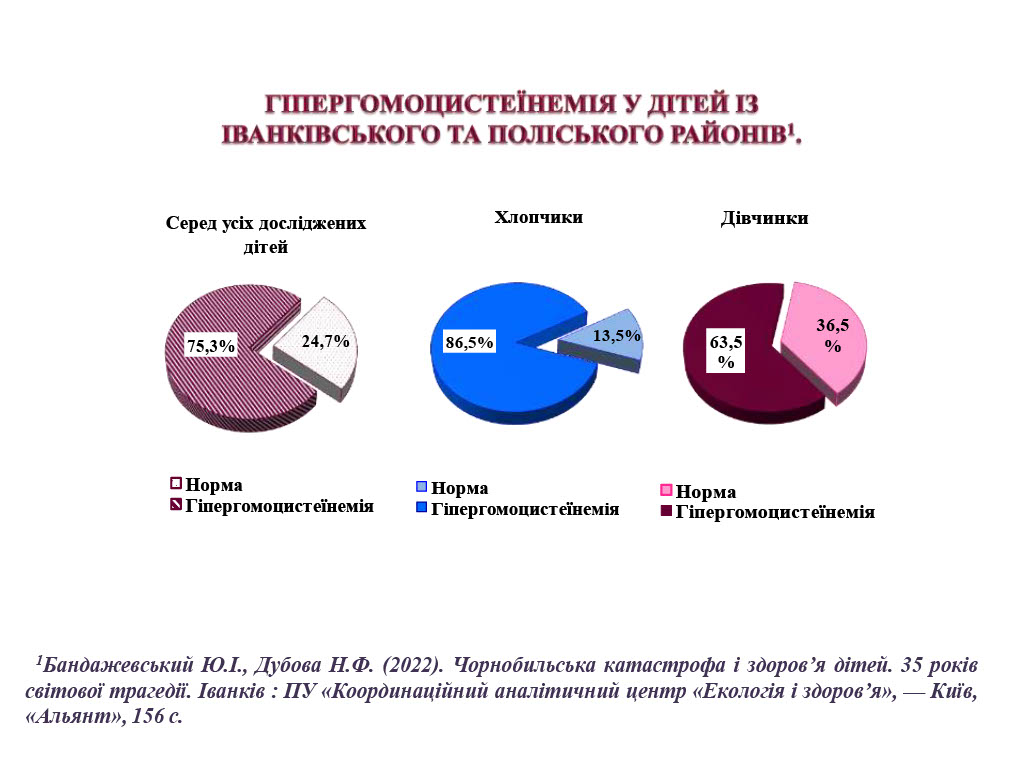
    слайд 17
    Слайд 17

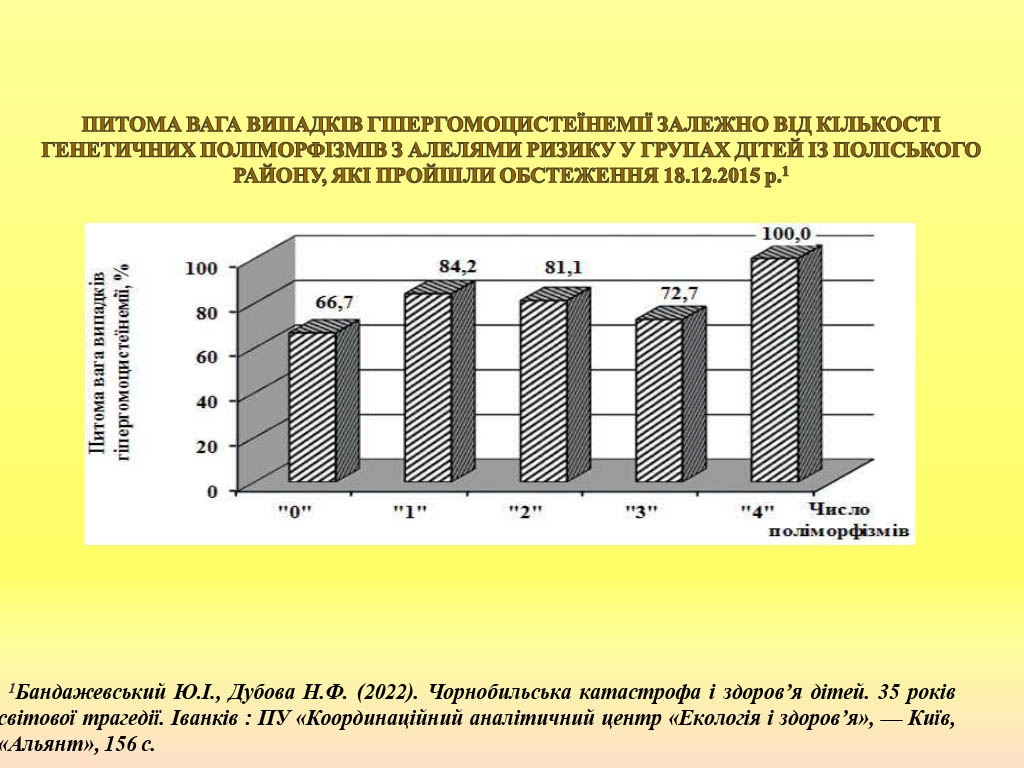
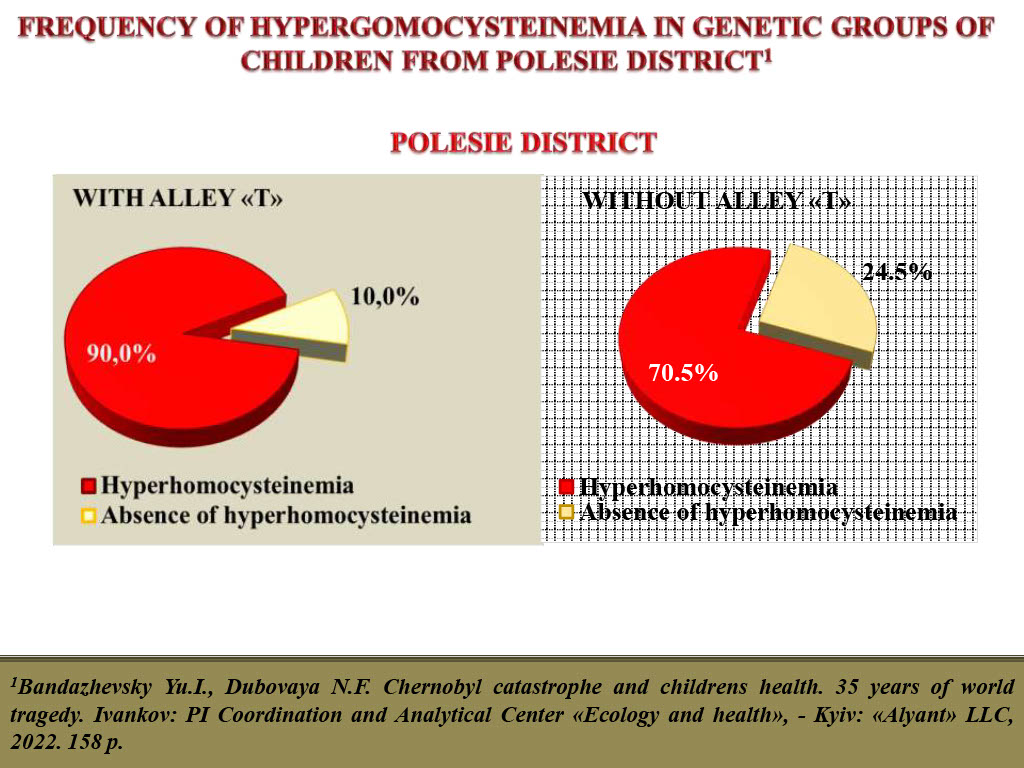
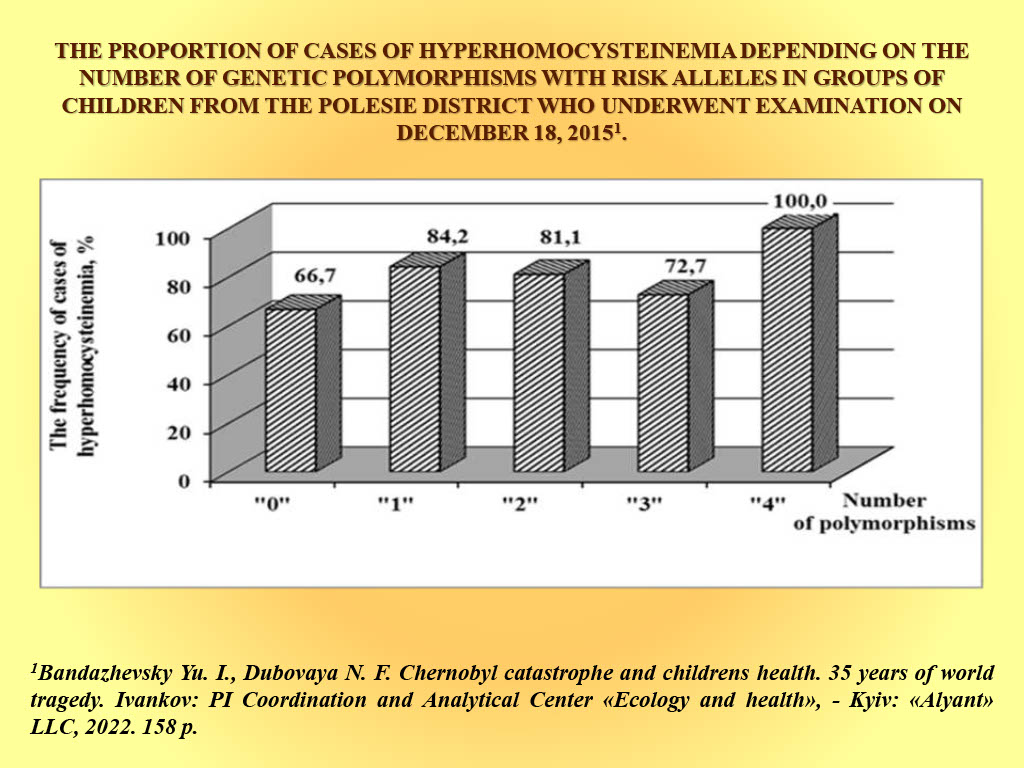
    Найбільше випадків гіпергомоцистеїнемії було виявлено у групі дітей - носіїв алелі Т генетичного поліморфізму MTHFR:677, у зв'язку з її гомозиготним варіантом [3] (слайд 18).
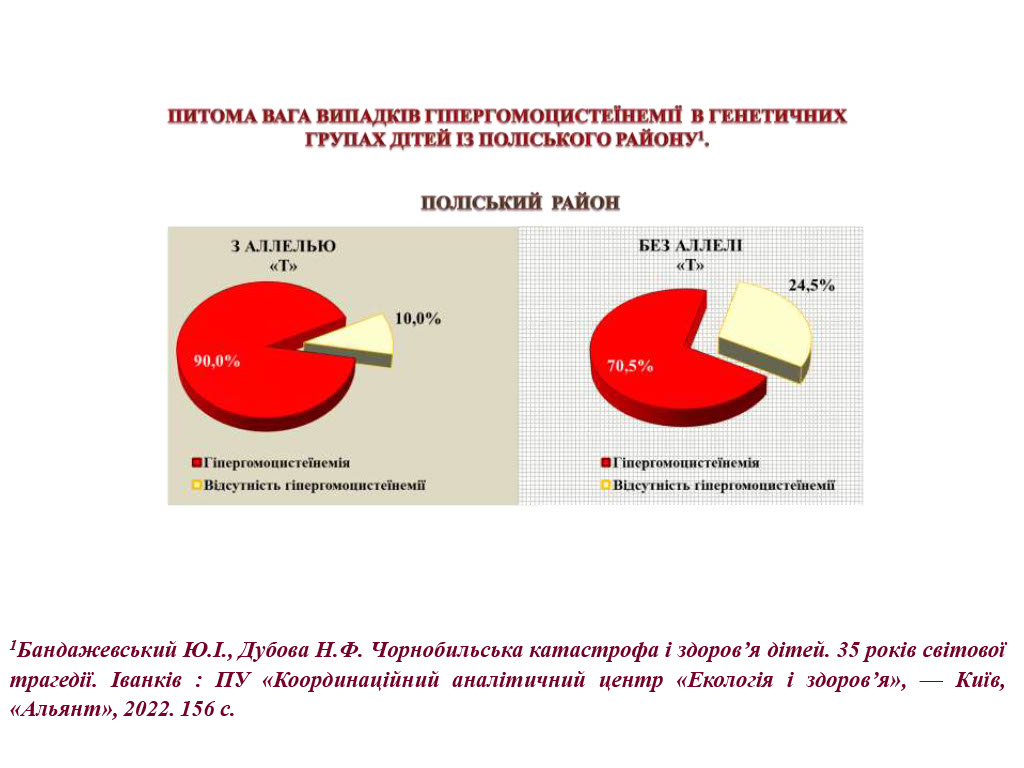
    слайд 18
    Слайд 18

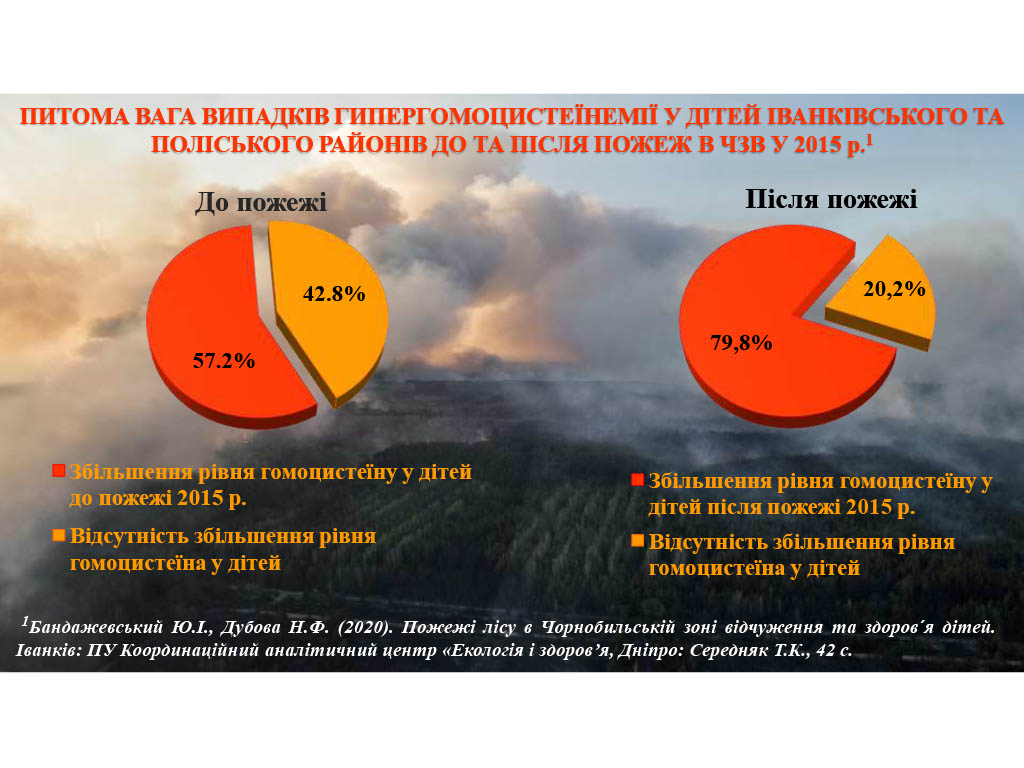
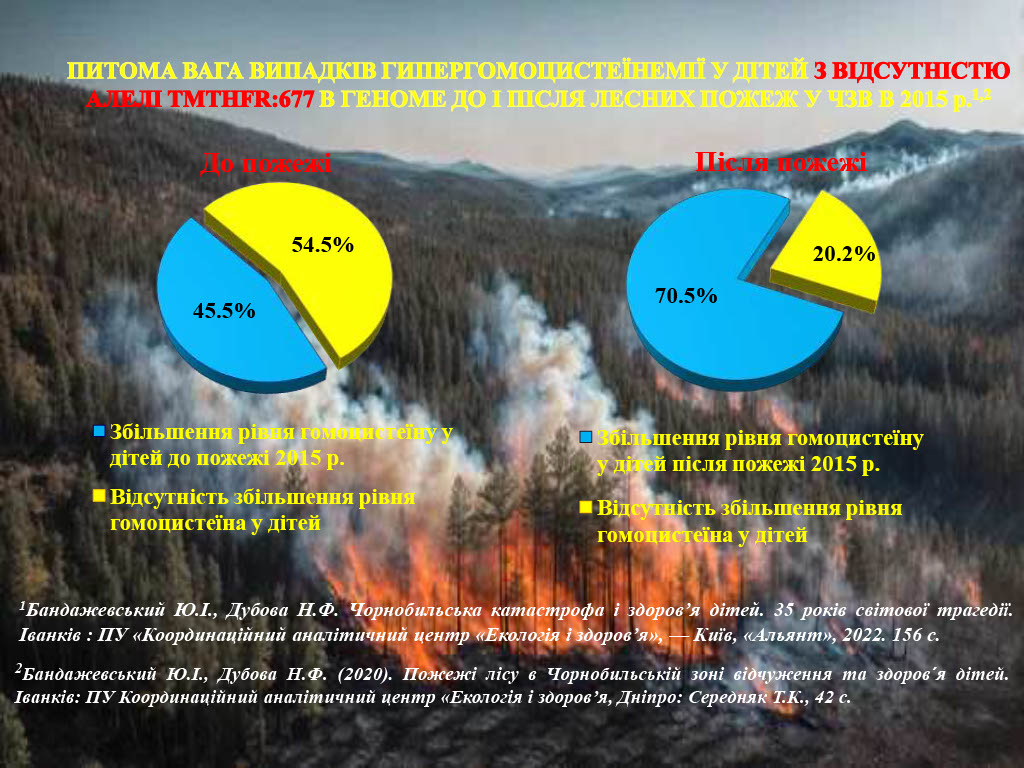
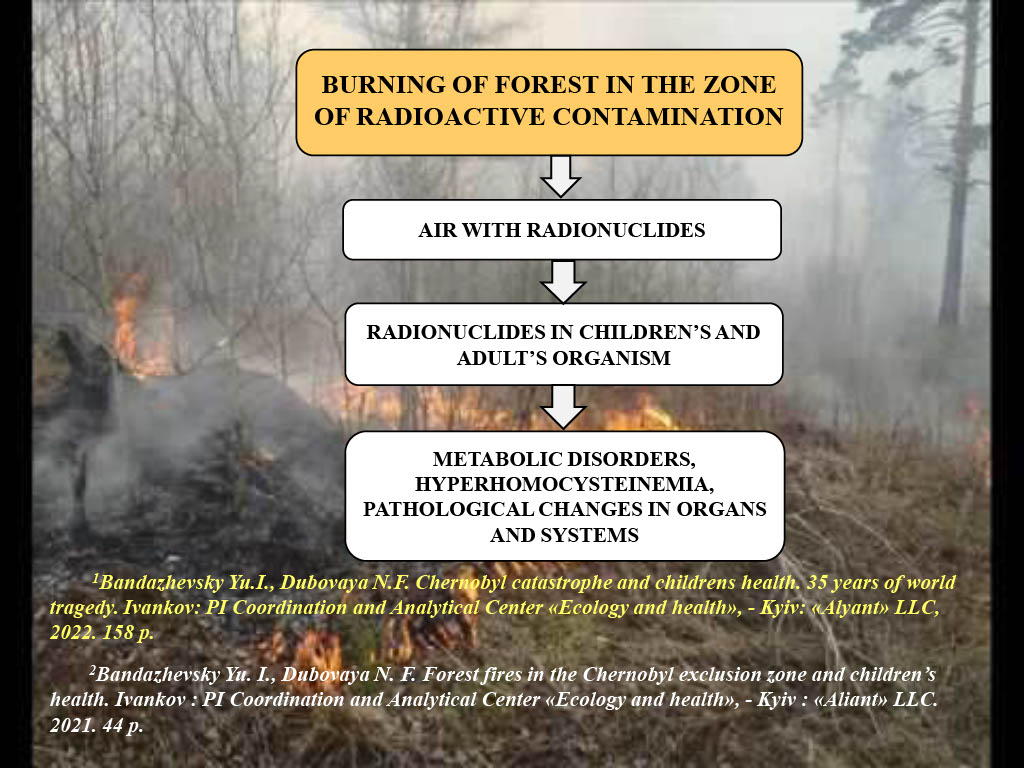
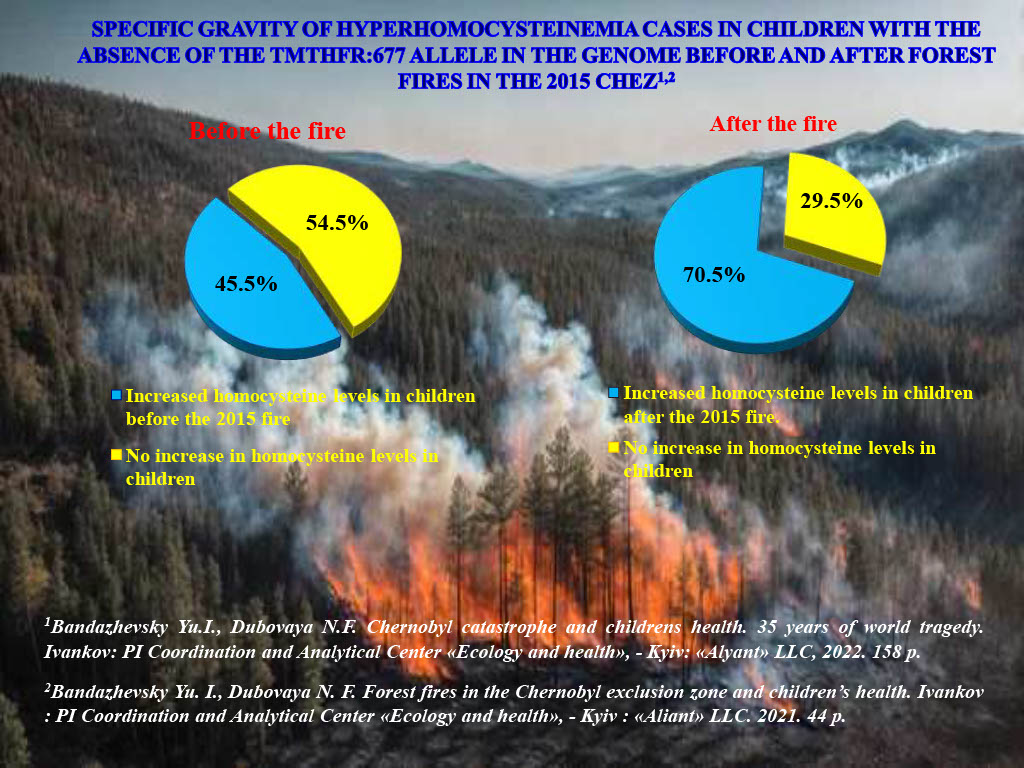
    Збільшення числа випадків гіпергомоцистеїнемії в досліджуваній групі дітей після лісових пожеж у ЧЗВ не було пов'язане з алелею Т MTHFR:677 [3, 10] (слайди 19, 20, 21).
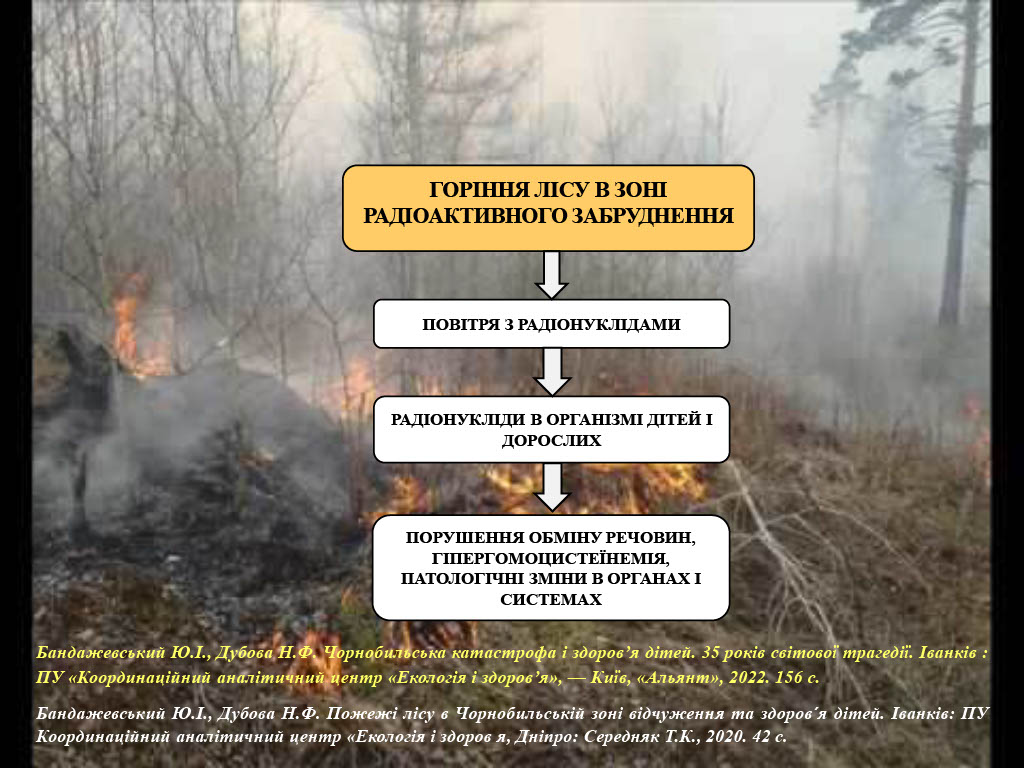
    слайд 19
    Слайд 19

    слайд 20
    Слайд 20

    слайд 21
    Слайд 21

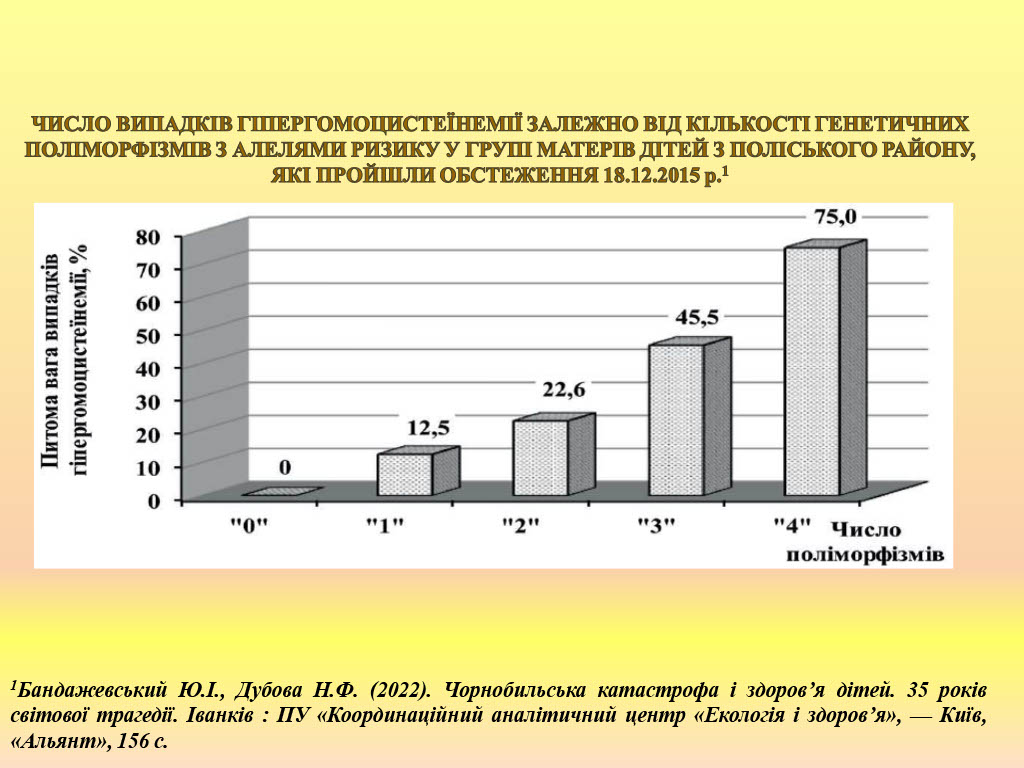
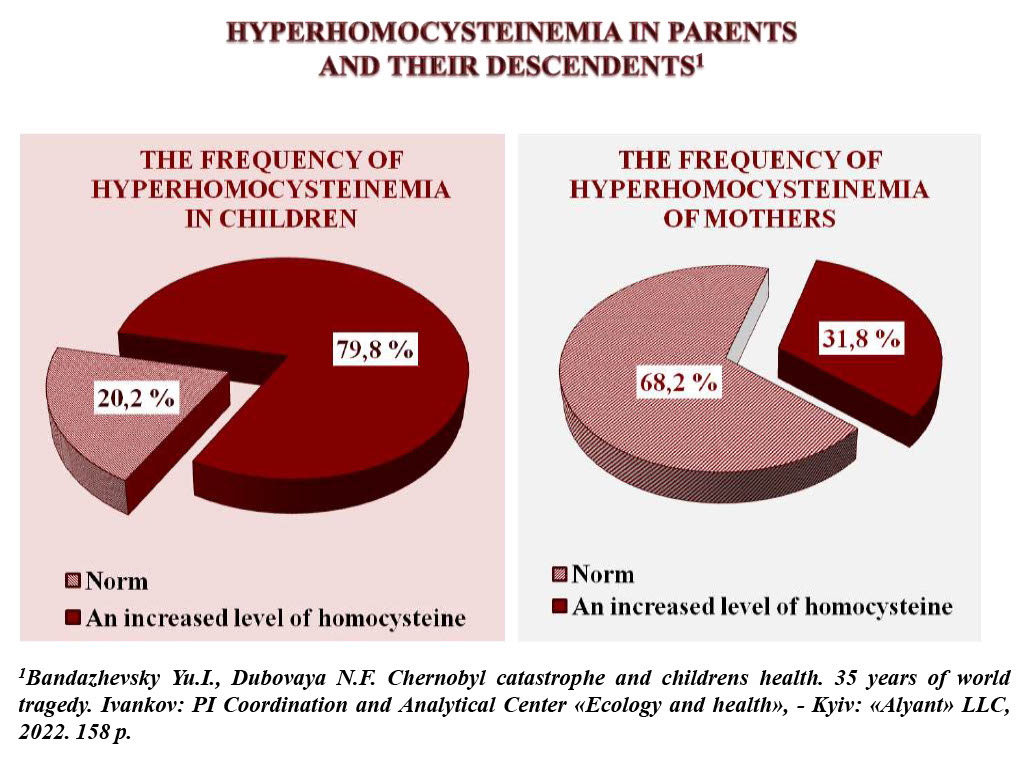
    У більшості випадків підвищення рівня гомоцистеїну в крові дітей не було пов'язане з генами фолатного циклу, на відміну від їх матерів, у яких рівень гомоцистеїну в крові був залежний від стану генетичного апарату, що контролює процес метилювання [3] (слайди 22, 23, 24).
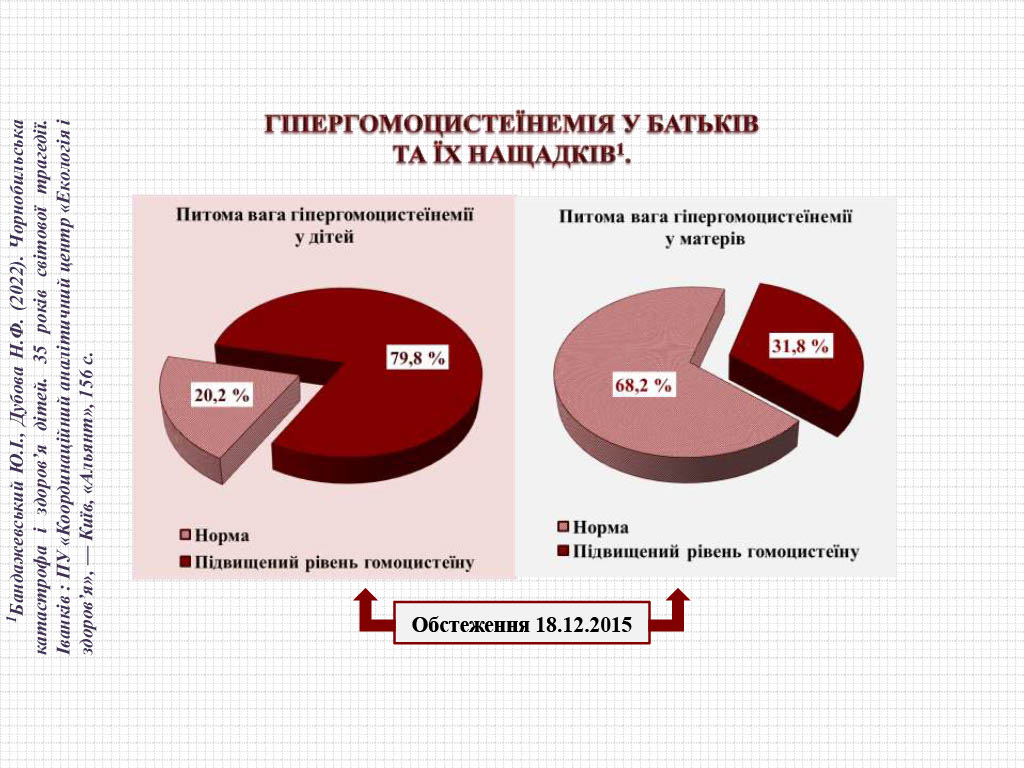
    слайд 22
    Слайд 22

    слайд 23
    Слайд 23

    слайд 24
    Слайд 24

    Проведення комплексних лабораторно-генетичних досліджень дозволило встановити те, що причиною гіпергомоцистеїнемії у дітей із районів, які постраждали від аварії на ЧАЕС, є порушення функціонування мітохондрій та зниження енергетичного потенціалу у клітинах життєво важливих органів.

    Після багаторічних аналітичних досліджень було зроблено висновок про те, що гіпергомоцистеїнемія у дітей, які мешкають поблизу ЧЗВ, є не лише проявом патологічного процесу, пов'язаного з порушенням утворення вторинного метіоніну, а й є елементом адаптаційної системи, спрямованої на корекцію обміну речовин в умовах радіаційного впливу

    При підвищенні концентрації гомоцистеїну в крові активується комплекс реакцій, спрямованих на усунення причин оксидативного стресу та відновлення мітохондрій як джерела енергетичних носіїв. У зв'язку з цим відбувається активація циклу реакцій транссульфурації, в якому відбувається утилізація гомоцистеїну з утворенням цистеїну та глутатіону – важливого елемента антиоксидантної системи [6].

    Найбільш виражений цей процес у дітей, які мешкають поблизу ЧЗВ, при порушенні функціонування В12 метіонін синтази у зв'язку з поліморфною алелю GMTR:2756 у геномі [6].

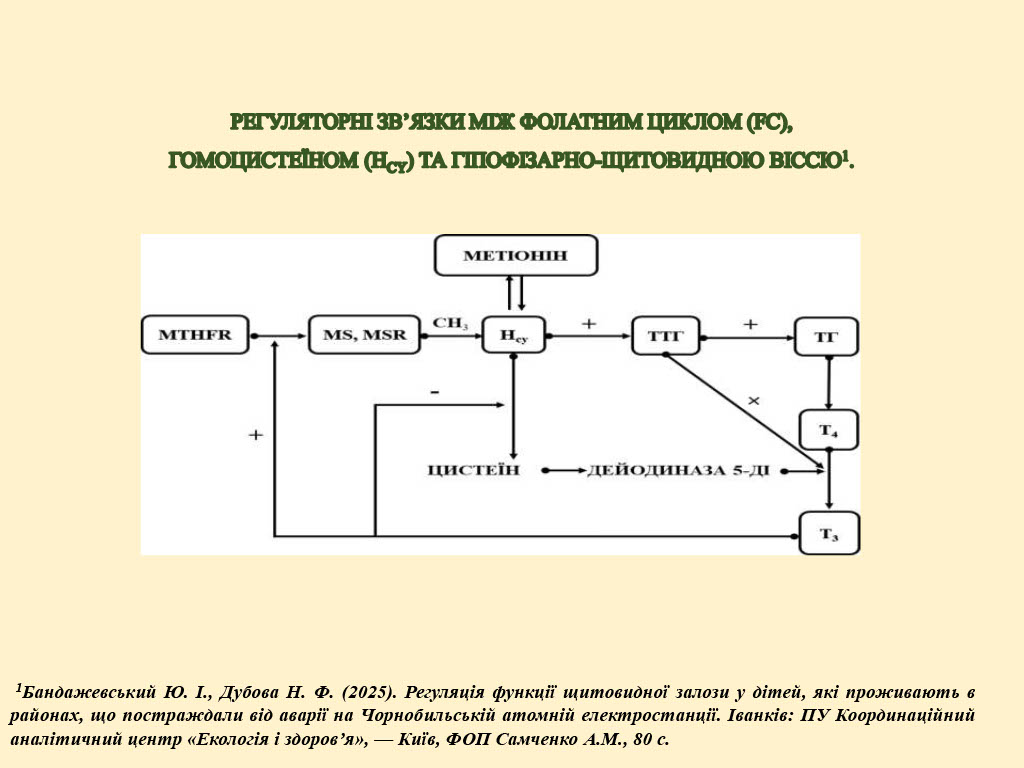
    Гомоцистеїн стимулює утворення трийодтироніну - активної форми гормонів щитовидної залози, здатної впливати на енергетичні процеси в мітохондріях [9] (слайд 25), а також, утворення кортизолу, що володіє антиоксидантною дією [6].
    слайд 25
    Слайд 25

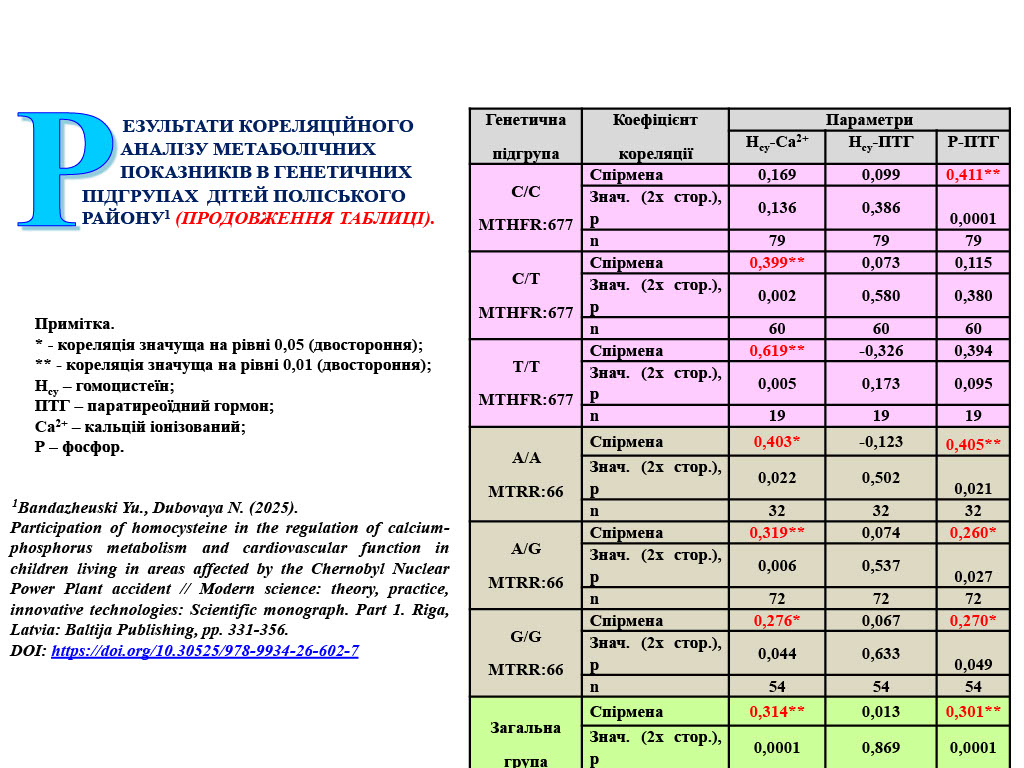
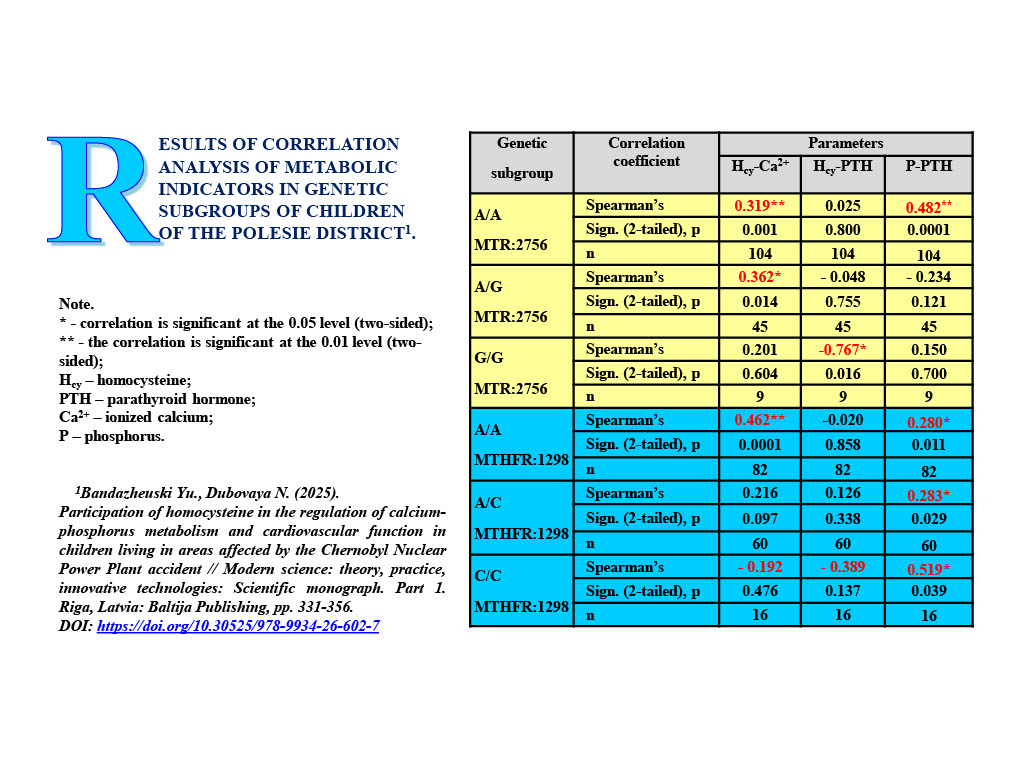
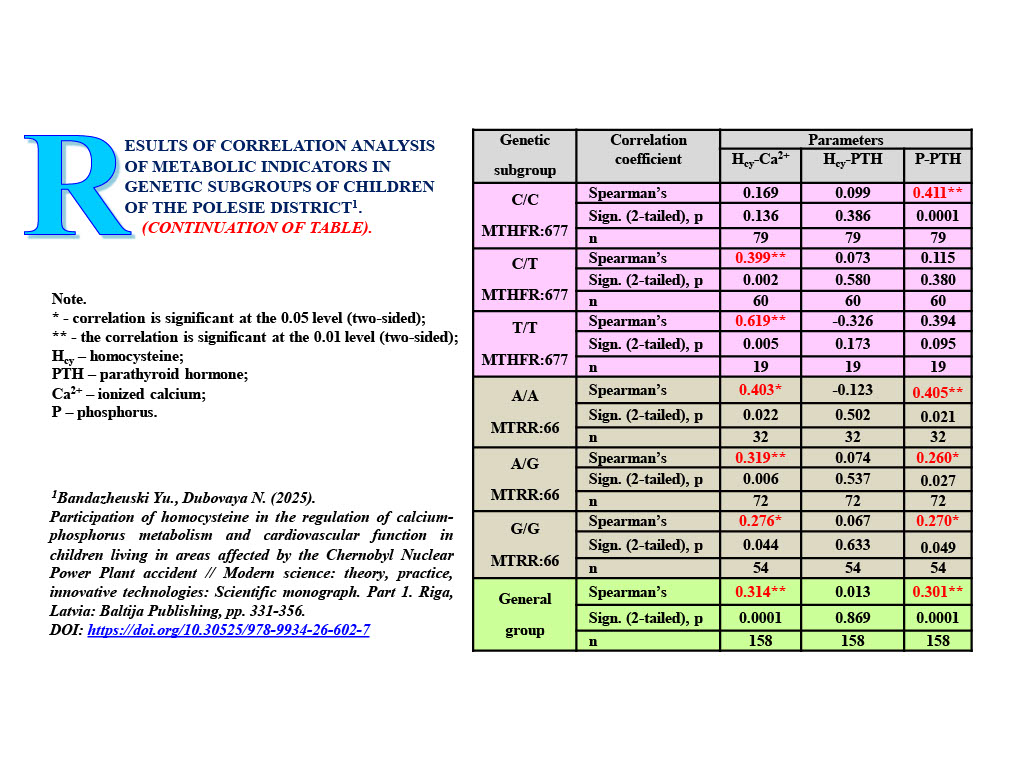
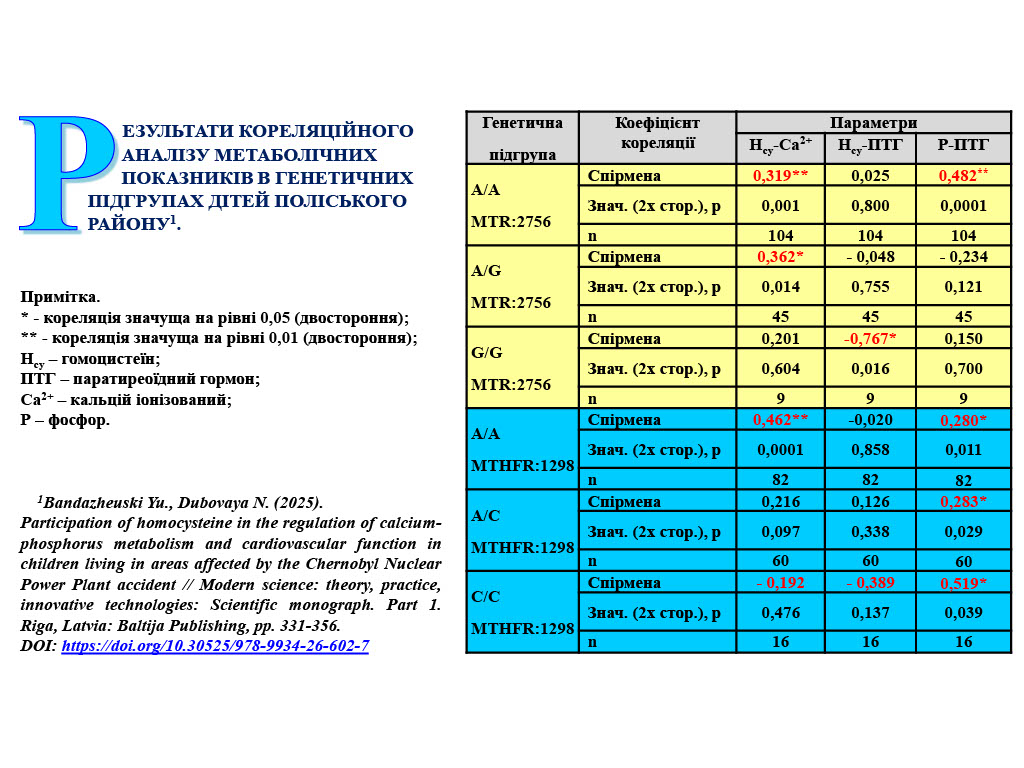
    Крім того, гомоцистеїн сприяє підвищенню концентрації сироваткового кальцію і цим підтримує іонну рівновагу між судинною системою та тканинами. При цьому слід звернути увагу на аллель Т генетичного поліморфізму MTHFRM:677 у геномі, при якій реєструвався найбільший прямий зв'язок між гомоцистеїном та сироватковим кальцієм [4] (слайди 26, 27). У ході проведених досліджень в більшості генетичних підгруп було виявлено прямий зв'язок між сироватовим фосфором і паратиреоїдним гормоном, що свідчить про здатність організму виводити фосфор через клубочкові структури нирок. Відсутність цього зв'язку в підгрупах дітей з алелями G MTR:2756 і MTHFR:677 є проявом порушення фосфорного обміну.
    слайд 26
    Слайд 26

    слайд 27
    Слайд 27

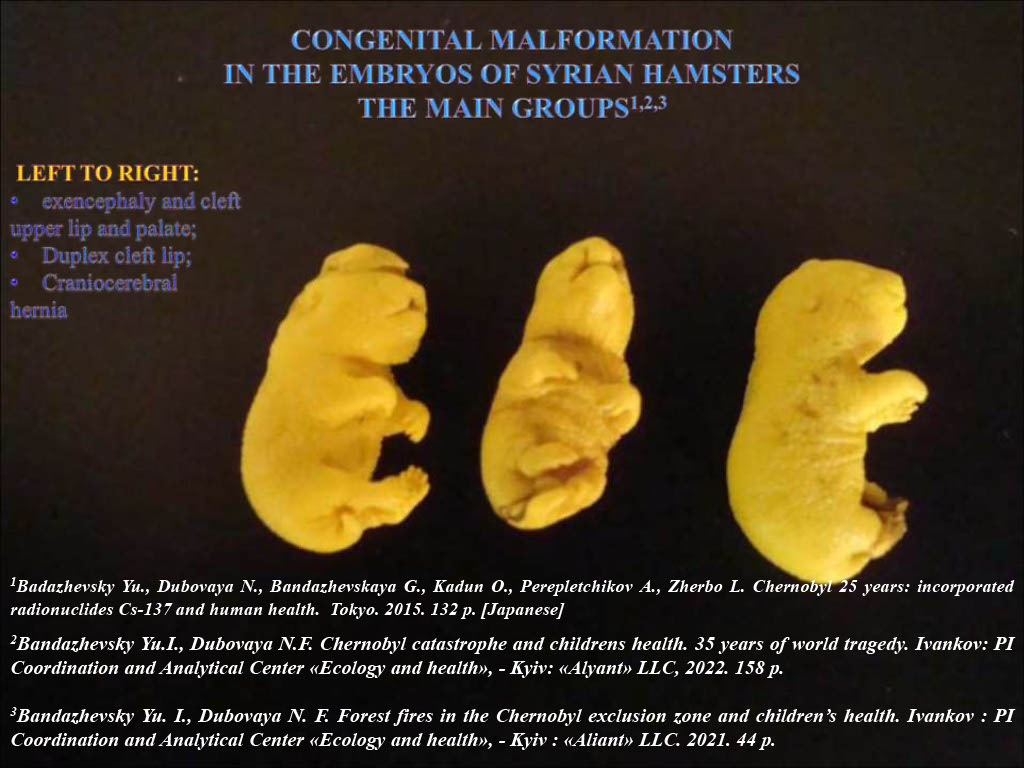
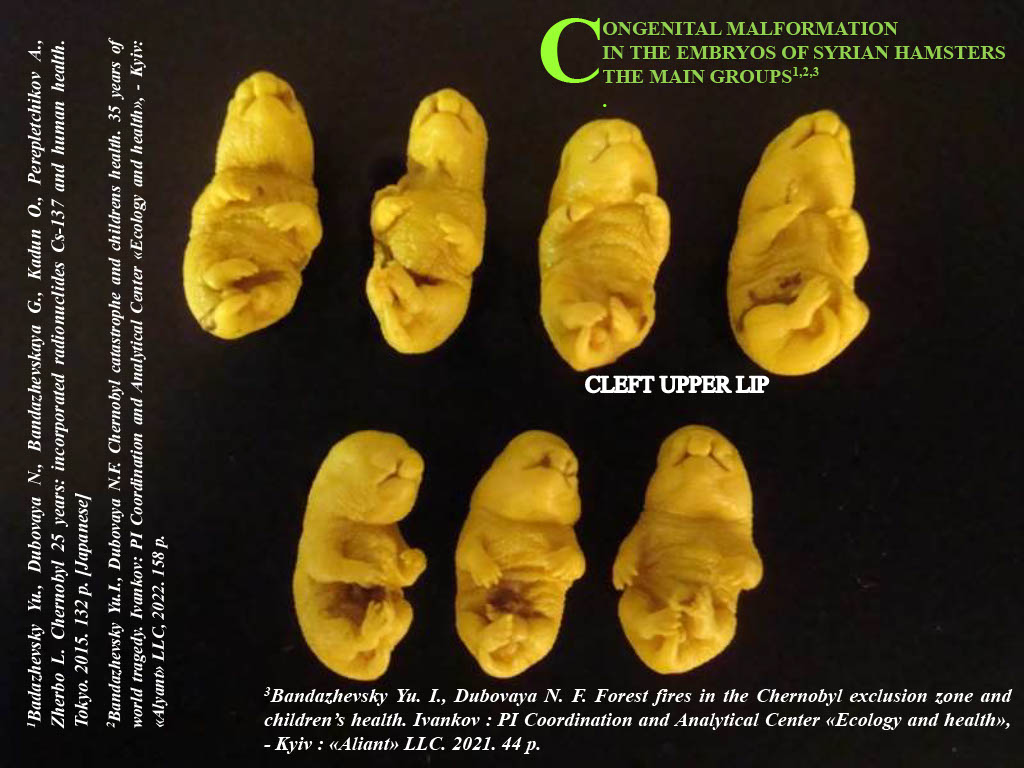
    У ході клінічних спостережень та експериментів з лабораторними тваринами виявлено тератогенну дію інкорпорованих в організмі радіонуклідів 137Cs

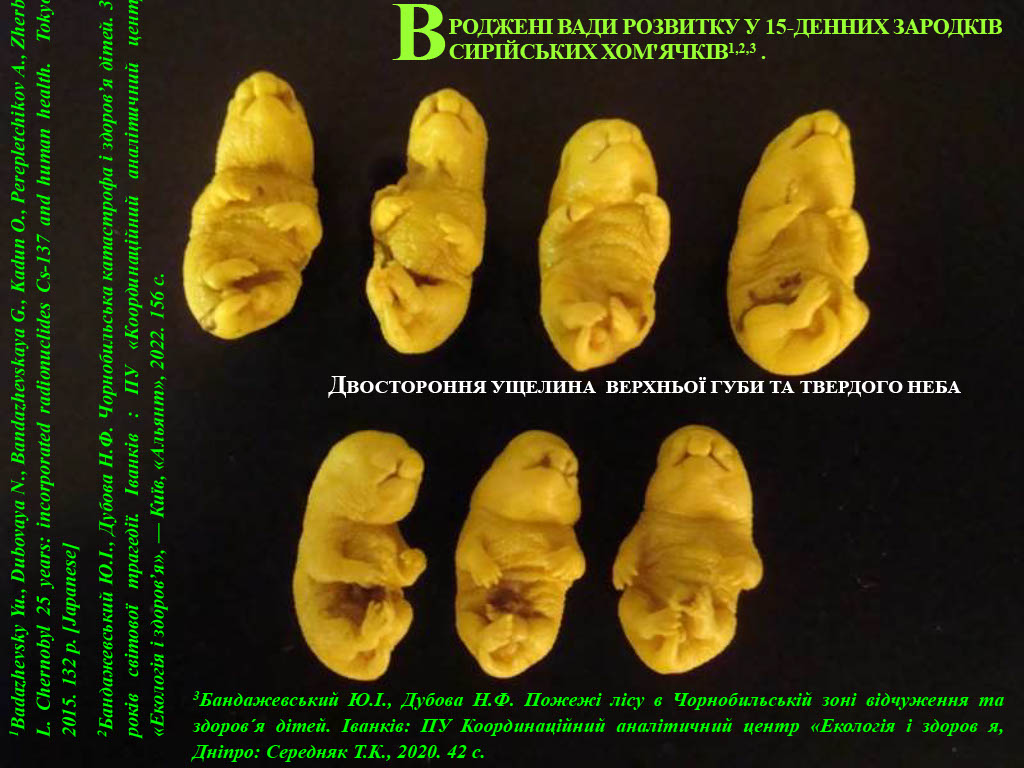
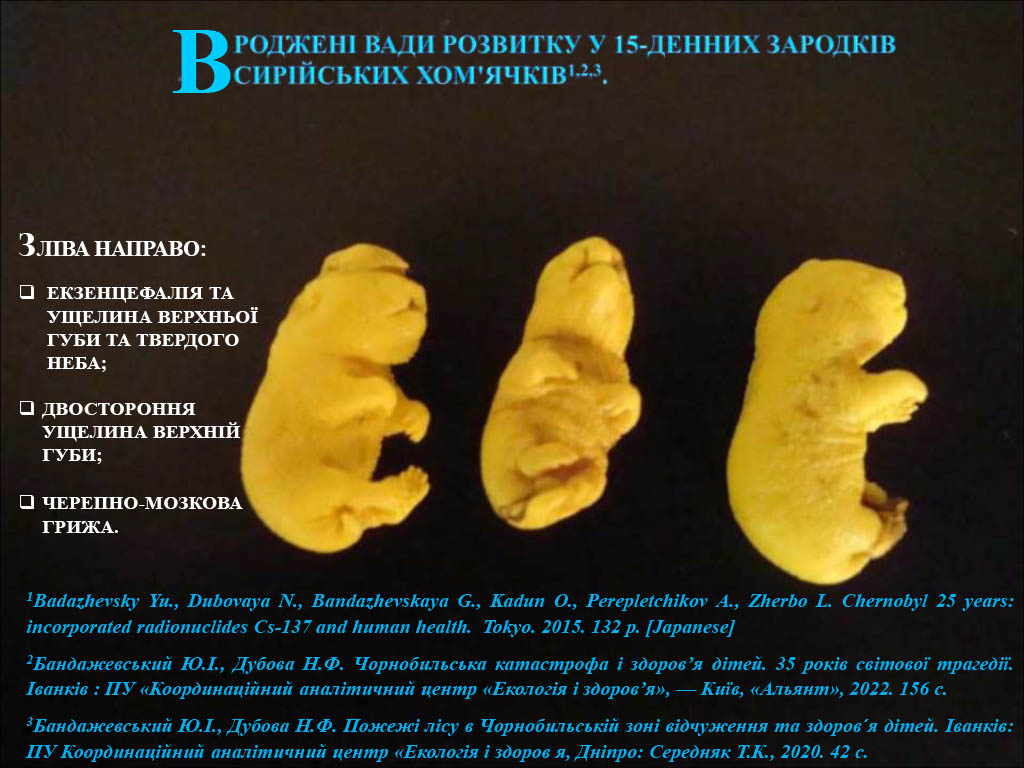
    Вроджені вади розвитку належали до групи мультифакторіальних вад, пов'язаних з генетичним та зовнішньосередовищним факторами. Вони включали головний мозок та лицьовий відділ черепа [2, 3, 10] (слайди 28, 29).
    слайд 28
    Слайд 28

    слайд 29
    Слайд 29

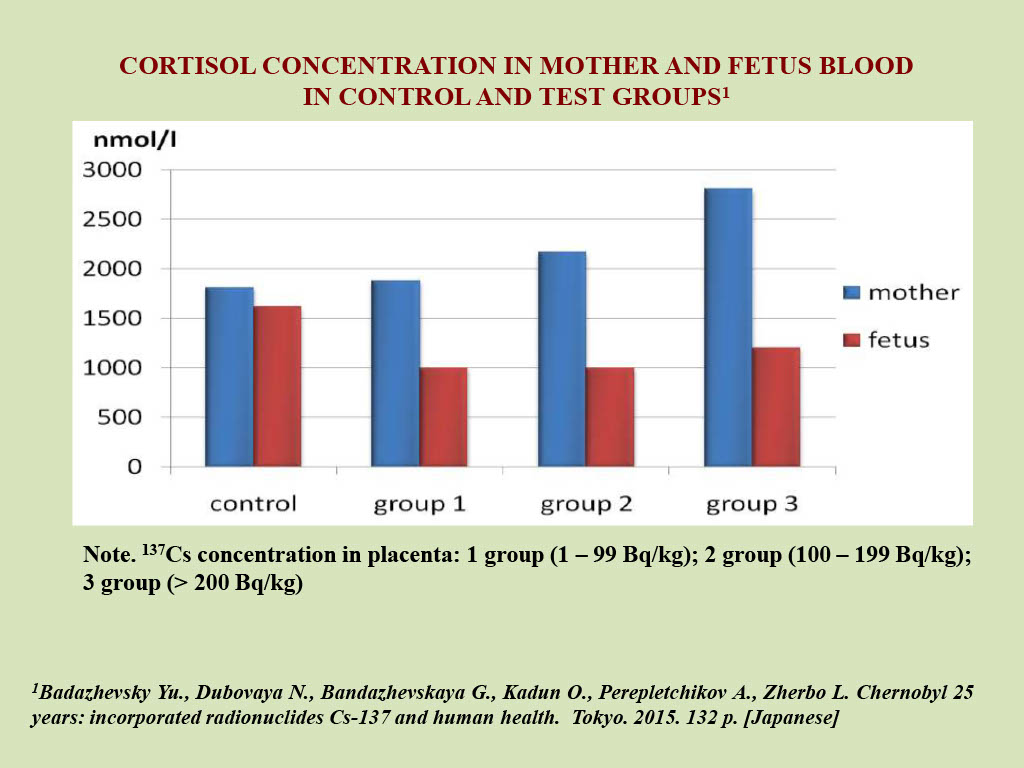
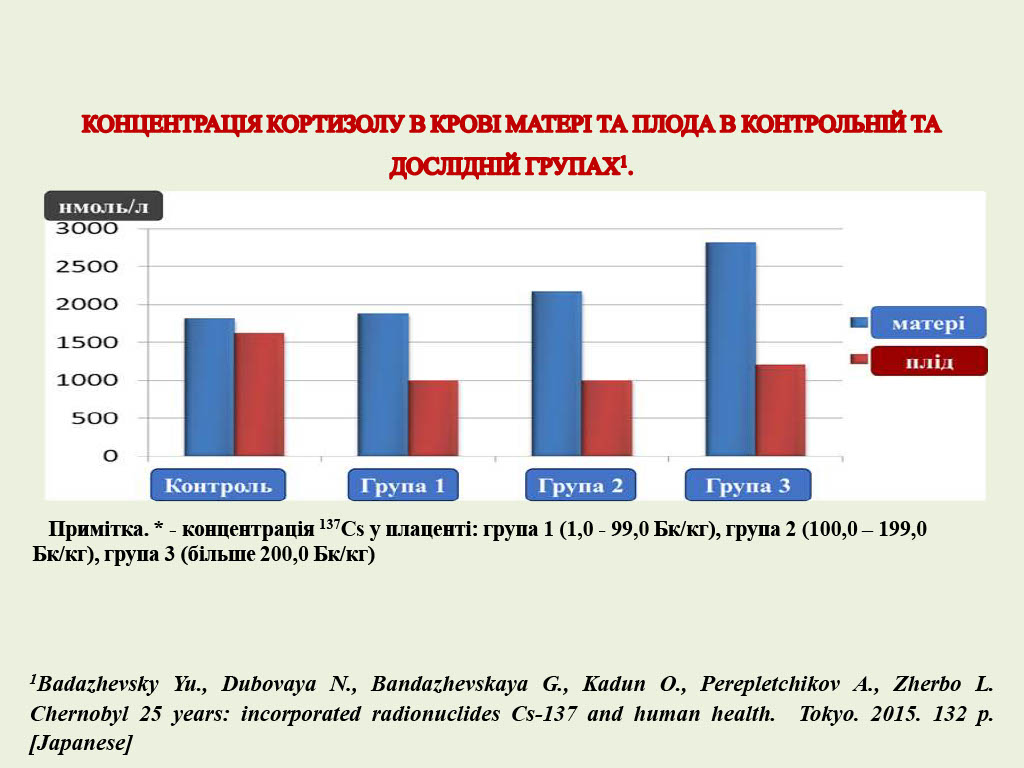
    Вплив радіонуклідів 137Cs у період вагітності на систему мати-плід призводить до порушення формування неспецифічної та специфічної резистентності організму, що розвивається. При цьому в крові плода зменшується вміст кортизолу [2] (слайд 30).
    слайд 30
    Слайд 30

    Отримана в ході реалізації в Україні проектів Європейської Комісії та Регіональної ради Рон-Альп інформація дозволяє зробити висновок про те, що порушення внутрішньоутробного розвитку, індуковані інкорпорованим 137Cs, пов'язані з процесом метилювання нуклеїнових кислот та білків

    Проведені дослідження дозволяють зробити наступний висновок щодо людської популяції, яка мешкає в районах, ґрунти яких забруднені радіонуклідами внаслідок аварії на ЧАЕС.

    У перше десятиліття після аварії на ЧАЕС у дорослих та дітей виникають онкологічні захворювання щитовидної залози та внутрішніх органів, кардіопатологія, патологія центральної нервової системи та внутрішніх органів пов'язані з впливом відносно великих доз коротко- та довгоживучих радіонуклідів. Характерним є синдром інкорпорованих довгоживучих радіонуклідів. У цей період відбувається порушення антенатального та постнатального онтогенезу, виникають вроджені вади розвитку мультифакторіальної групи.

    У віддалений період аварії на ЧАЕС у дорослого населення виникають онкологічні захворювання, кардіопатологія, патологія внутрішніх органів та центральної нервової системи.

    У дітей другого чорнобильського покоління реєструються вроджені структурно-функціональні порушення внутрішніх органів, нервової та кістково-суглобової системи. Зменшення адаптаційних можливостей дитячого організму призводить до серцево-судинної, інфекційної та онкозахворюваності, зниження резистентності до впливу радіації, хімічних та фізичних агентів.

    Гіпергомоцистеїнемія у більшості дітей другого чорнобильського покоління, які мешкають поблизу ЧЗВ, є проявом патологічного процесу, що стосується життєво важливих органів.

    На наш погляд, це пов'язано з впливом 137Cs та інших радіонуклідів на систему мати-плід, внаслідок чого в організмі, що розвивається, змінюються регуляторні зв'язки між метаболічними процесами в життєво важливих органах

    Наслідком цього є зменшення утворення компонентів антиоксидантної системи, у тому числі кортизолу, що призводить, при інкорпорації 137Cs до пошкодження мітохондрій і, як наслідок, до порушення процесу метилювання гомоцистеїну, зменшення утворення внутрішнього метіоніну та аденозилметіоніну - основного джерела метильних груп.

    Однак, у ряді випадків гіпергомоцистеїнемія є компонентом адаптаційної реакції організму в умовах радіаційного впливу


    Литературні джерела.

    1. Bandazhevsky Yu.I. Chronic Cs-137 incorporation in children's organs. Swiss Medical Weekly. 2003. Vol. 133. P. 488 - 490. DOI: https://doi.org/10.4414/smw.2003.10226

    2. Badazhevsky Yu., Dubovaya N., Bandazhevskaya G., Kadun O., Perepletchikov A., Zherbo L. Chornobyl 25 years: incorporated radionuclides Cs-137 and human health. Tokyo. 2015. 132 p. [Japanese]

    3. Бандажевський Ю.І., Дубова Н.Ф. Чорнобильська катастрофа і здоров’я дітей. 35 років світової трагедії. Іванків : ПУ «Координаційний аналітичний центр «Екологія і здоров’я», — Київ, «Альянт», 2022. 156 с.

    4. Bandazheuski Yu., Dubovaya N. Participation of homocysteine in the regulation of calcium-phosphorus metabolism and cardiovascular function in children living in areas affected by the Chornobyl Nuclear Power Plant accident // Modern science: theory, practice, innovative technologies : Scientific monograph. Part 1. Riga, Latvia : Baltija Publishing, 2025. P. 331-356. DOI: https://doi.org/10.30525/978-9934-26-602-7

    5. Bandajevsky Y. I., Bandajevskaya G. Cardiomyopathies on cesium 137. Cardinale. revue de cardiologie. 2003. Vol. 15. № 8. P. 40-42. [French].

    6. Bandazheuski Yu., Dubovaya N. Folate cycle genes and adaptation processes in children living near the Chornobyl Exclusion Zone // Transformation of the scientific area in the context of contemporary challenges : Scientific monograph. Riga, Latvia : Baltija Publishing, 2025. P. 242-260. DOI: https://doi.org/10.30525/978-9934-26-631-7-10

    7. Dubovaya N., Bandazheuski Yu. Adaptation resources of the cardiovascular system of schoolchildren living near the Chornobyl nuclear power plant // Scientific space: integration of traditional and innovative processes: Scientific monograph. Riga, Latvia: Baltija Publishing, 2023. P. 147-170. DOI: https://doi.org/10.30525/978-9934-26-310-1-5

    8. Дубова Н.Ф., Бандажевський Ю.І. Оцiнка адаптацiйних можливостей серцево-судинноi системы школярiв, якi мешкають поблизу Чорнобильськоi зони вiдчуження. Довкілля та здоров’я. 2023. № 2 (107). P. 24-30. DOI: https://doi.org/10.32402/dovkil2023.02.024

    9. Бандажевський Ю.І., Дубова Н.Ф. Регуляція функції щитовидної залози у дітей, які проживають в районах, що постраждали від аварії на Чорнобильській атомній електростанції. Іванків : ПУ Координаційний аналітичний центр «Екологія і здоров’я», - Київ, ФОП Самченко А.М., 2025. 80 с.

    10. Бандажевський Ю.I., Дубова Н.Ф. Пожежi лiсу в Чорнобильськiй зонi вiдчуження та здоров´я дiтей. Iванкiв: ПУ Координацiйний аналiтичний центр «Екологiя i здоров я, Днiпро: Середняк Т.К., 2020. 42 с.
    скачати | скачати слайди

    • Укр
    • Eng
    • Fra

    PATHOLOGICAL AND ADAPTATION PROCESSES IN CHILDREN'S BODY AFTER THE ACCIDENT AT THE CHORNOBYL NUCLEAR POWER PLANT

    Bandazhevsky Yu. I., Dubovaya N. F.

    Ecology and Health Coordination and Analytical Centre, Ukraine (Kyiv 2026)

    Our research over many decades allows us to draw a number of important conclusions regarding the radiation impact on the human population following the accident at the Chornobyl nuclear power plant (ChNPP).

    The Chornobyl accident resulted in the release of a huge amount of radioactive elements into the environment, predominantly 137Cs. This radionuclide decays with the release of gamma and beta radiation, forming stable 137Ba.

    137Cs entered and continues to enter the bodies of residents of the affected areas primarily through the enteral route with food of animal and plant origin.

    In the USSR, as well as several independent states that emerged as a result of its dissolution, permissible levels of 137Cs and 90Sr in food products were established by law.

    The rationale for creating these regulations was economic feasibility, based on the existence of agricultural products with certain levels of 137Cs and 90Sr in various years after the Chornobyl accident.

    As the specific activity of these radionuclides in food products decreased, regulatory requirements were tightened.

    However, this did not exclude the constant intake of radioactive elements into the human body.

    Thus, the legislation permitted the enteral ingestion of significant quantities of 137Cs and 90Sr.

    However, the impact of these radionuclides on the health of children and adults was not determined.

    Radiation exposure of residents of the affected areas is facilitated by forest fires in the Chornobyl Exclusion Zone (ChEZ), as well as the use of wood containing radioactive elements

    For many decades, millions of people have lived and continue to live under conditions of constant radiation exposure.

    In the first decade after the Chornobyl accident, 137Cs intake by children and adults was significant, allowing us to determine the incorporation of this radionuclide into individual internal organs.

    Contrary to previous belief, we have established that 137Cs is intensively absorbed by the thyroid and pancreas, liver, kidneys, heart muscle, and even the brain [1] (slide 2).

    slide 2
    Slide 2

    To assess the impact of 137Cs radionuclides on metabolic processes in the bodies of residents of the affected areas, we conducted numerous clinical, instrumental, pathological, and biochemical studies of children and adults, as well as experiments on laboratory animals.

    These studies assessed structural and metabolic changes in vital organs at varying specific activity levels of 137Cs in the body.

    The simultaneous penetration of 137Cs into the tissue of the heart, liver, kidneys, thyroid gland, and other internal organs caused damage to their cellular structures, resulting in the syndrome of incorporated long-lived radionuclides (SLIR) [2]. The underlying pathological processes are mitochondrial damage and disruption of cellular energetics.

    At a specific activity of 137Cs in the body of 30-50 Bq/kg, ultramicroscopic examination revealed an increase in mitochondrial size and fusion in myocardial cells, indicating not only damage but also the development of reparative processes [2] (slide 3).

    slide 3
    Slide 3

    Furthermore, significant structural changes occurred in myocardial tissue, which may be the cause of death [2] (slide 4).

    slide 4
    Slide 4

    During the studies conducted in Ukraine in 2013-2017 within the framework of the projects of the European Commission and the Regional Council of Rhone-Alpes (France), in a group of children living near the ChEZ, damage to the mitochondria of cardiomyocytes was detected in 37.5% of cases [3].

    In these studies, mitochondrial damage in children's cardiomyocytes was assessed based on the activity of serum transaminases—aspartate aminotransferase (AST) and alanine aminotransferase (ALT).

    The negative impact of incorporated 137Cs radionuclides on the mitochondria of cardiomyocytes in the children studied is reflected by the direct relationship between 137Cs specific activity and serum AST levels [3] (slide 5).

    slide 5
    Slide 5

    The inverse correlation between 137Cs specific activity in the body and serum calcium concentration [4] (slide 6) reflects energy deficiency caused by impaired mitochondrial function, which contributes to the disruption of the ionic composition within the cells of the cardiac leading system and the development of arrhythmias

    The reduction in the energetic capacity of cardiomyocytes due to the influence of incorporated 137Cs radionuclides leads to a decrease in the contractility of the heart muscle, which leads to a decrease in blood pressure and a reduction in the blood supply to organs and systems [4] (slide 6). This results in impaired physical development of the child.

    The negative impact of incorporated 137Cs on anabolic processes in the developing child's body reflects the inverse correlation between the specific activity of this radionuclide in the body and the Rohrer index values [4] (slide 6).

    slide 6
    Slide 6

    In the first decade after the Chornobyl accident, a direct correlation was found between the frequency of electrocardiographic changes, predominantly represented by incomplete right bundle branch block, and the specific activity of 137Cs in the body in a group of children living in the affected area [2, 5] (slide 7).

    slide 7
    Slide 7

    A similar correlation was found in the development of cataracts in children living in areas with 137Cs soil contamination densities of 5-15 Ci/km2 and 15-40 Ci/km2 [2] (slide 8).

    slide 8
    Slide 8

    Heart rate disturbances were also detected in most children of the second generation of Chornobyl survivors living near the ChEZ [3] (slide 9).

    slide 9
    Slide 9

    However, the specific activity of 137Cs in these children's bodies was significantly lower than in children examined in the first decade after the Chornobyl accident [6].

    Mitochondrial dysfunction in children living near the ChEZ, which arose in the late post-Chornobyl period under the influence of incorporated 137Cs, became one of the main causes of impaired adaptation processes and reduced cardiovascular reserve capacity.

    Poor adaptation and failure of adaptation mechanisms were recorded in 50% of cases [7,8] (slide 10). Below-average cardiovascular functional reserve was detected in 40.3% of cases, and low levels were detected in 31.3% of cases [7,8] (slide 11).

    slide 10
    Slide 10

    slide 11
    Slide 11

    Pathological changes in the kidneys cause metabolic disorders in the body.

    The kidneys are the organs that eliminate 137Cs from the body. The most pronounced pathological changes were found in the glomerular apparatus. The most common manifestation was progressive destruction of glomerular structures, leading to complete disappearance—the "melting ice floe" phenomenon [2] (slide 12).

    slide 12
    Slide 12

    The results of ultrasound examination indicate serious structural changes in the liver and metabolic disorders in 35.0% of children living near the ChEZ [3] (slide 13).

    slide 13
    Slide 13

    Studies have revealed a direct correlation between the specific activity of 137Cs in the body and indicators reflecting vital functions in children [3] (slide 14).

    slide 14
    Slide 14

    Under conditions of energy deficiency associated with the incorporation of 137Cs into the body, a large number of children developed hyperhomocysteinemia— elevated blood levels of the amino acid homocysteine.

    Homocysteine is a sulfur-containing amino acid that is an intermediate in the metabolic cycles of the essential amino acid methionine, which is a source of methyl groups for the body [9] (slide 15).

    slide 15
    Slide 15

    Homocysteine levels in the blood reflect the efficiency of methylation of nucleic acids and protein molecules.

    An increase in homocysteine concentrations in the blood indicates a disruption in its methylation and a decrease in the formation of endogenous methionine.

    In adults, hyperhomocysteinemia is associated with a number of severe cardiovascular diseases, oncological processes, and pathologies of the central nervous system [3] (slide 16).

    slide 16
    Slide 16

    During the implementation of projects by the European Commission and the Rhône-Alps Regional Council in 2015, hyperhomocysteinemia was identified for the first time in a large number of children living near the ChEZ [3] (slide 17).

    slide 17
    Slide 17

    The highest number of cases of hyperhomocysteinemia was detected in the group of children carrying the T allele of the MTHFR:677 genetic polymorphism, due to its homozygous variant [3] (slide 18).

    slide 18
    Slide 18

    The increase in hyperhomocysteinemia cases in the study group of children following the forest fires in the ChEZ was not associated with the T allele of MTHFR:677 [3,10] (slides 19, 20, 21).

    slide 19
    Slide 19

    slide 20
    Slide 20

    slide 21
    Slide 21

    In most cases, elevated homocysteine levels in the children's blood were not associated with folate cycle genes, unlike in their mothers, whose blood homocysteine levels were dependent on the state of the genetic apparatus controlling the methylation process [3] (slides 22, 23, 24).

    slide 22
    Slide 22

    slide 23
    Slide 23

    slide 24
    Slide 24

    Comprehensive laboratory and genetic studies have established that the cause of hyperhomocysteinemia in children from areas affected by the Chornobyl accident is impaired mitochondrial function and reduced energy potential in the cells of vital organs.

    After years of analytical research, it was concluded that hyperhomocysteinemia in children living near the Chornobyl accident is not only a manifestation of a pathological process associated with impaired secondary methionine formation, but is also an element of the adaptive system aimed at correcting metabolism under radiation exposure.

    When homocysteine concentrations in the blood increase, a complex of reactions is activated aimed at eliminating the causes of oxidative stress and restoring mitochondria as energy sources.

    This activates the transsulfuration reaction cycle, which utilizes homocysteine to form cysteine and glutathione, an important component of the antioxidant system [6].

    This process is most pronounced in children living near the ChEZ, with a disruption in the functioning of B12 methionine synthase due to the polymorphic allele GMR:2756 in the genome [6].

    Homocysteine stimulates the formation of triiodothyronine, the active form of thyroid hormone that can influence energy processes in the mitochondria [9] (slide 25), as well as the formation of cortisol, which has an antioxidant effect [6].

    slide 25
    Slide 25

    Furthermore, homocysteine promotes an increase in serum calcium concentrations, thereby maintaining ionic balance between the vascular system and tissues.

    It is worth noting the subgroup of children carrying the T allele of the MTHFRM:677 genetic polymorphism. This subgroup demonstrated the strongest direct association between homocysteine and serum calcium [4] (slides 26, 27).

    slide 26
    Slide 26

    slide 27
    Slide 27

    In the course of studies conducted in most genetic subgroups, a direct association was found between serum phosphorus and parathyroid hormone, indicating the body's ability to excrete phosphorus through the glomerular structures of the kidneys.

    The absence of this association in the subgroups of children with the G alleles of MTR:2756 and T alleles of MTHFR:677 is a manifestation of a disorder of phosphorus metabolism.

    Clinical observations and experiments with laboratory animals have revealed the teratogenic effect of 137Cs radionuclides incorporated into the body.

    Congenital malformations belonged to a group of multifactorial defects associated with genetic and environmental factors. They involved the brain and facial region of the skull [2,3,10] (slides 28, 29).

    slide 28
    Slide 28

    slide 29
    Slide 29

    The effect of 137Cs radionuclides on the fetus during pregnancy disrupts the development of nonspecific and specific resistance in the developing organism. At the same time, fetal blood cortisol levels decrease [2] (slide 30).

    slide 30
    Slide 30

    The information obtained during the implementation of projects of the European Commission and the Rhône-Alps Regional Council in Ukraine allows us to conclude that intrauterine developmental disorders induced by incorporated 137Cs are associated with the process of methylation of nucleic acids and proteins.

    These studies allow us to draw the following conclusion regarding the human population living in areas where soils are contaminated with radionuclides as a result of the Chornobyl accident.

    In the first decade after the Chornobyl accident, adults and children develop oncological diseases of the thyroid gland and internal organs, cardiopathology, pathology of the central nervous system and internal organs associated with exposure to relatively large doses of short- and long-lived radionuclides.

    A syndrome of incorporated long-lived radionuclides is characteristic.

    During this period, antenatal and postnatal ontogenesis are disrupted, and congenital malformations of a multifactorial nature arise.

    In the late period following the Chornobyl accident, adults develop cancer, cardiac pathologies, and pathologies of internal organs and the central nervous system.

    Children of the second generation of Chornobyl survivors have been diagnosed with congenital structural and functional disorders of their internal organs, nervous system, and musculoskeletal system. Reduced adaptive capacity of children leads to cardiovascular, infectious, and oncological diseases, as well as decreased resistance to radiation, chemical, and physical agents.

    Hyperhomocysteinemia in most children of the second generation of Chornobyl victims living near the ChEZ is a manifestation of a pathological process affecting vital organs.

    We believe this is due to the effects of 137Cs and other radionuclides on the maternal-fetal system, which alters the regulatory relationships between metabolic processes in vital organs in the developing organism. This results in a decrease in the production of antioxidant system components, including cortisol. This, upon incorporation of 137Cs, leads to mitochondrial damage and, consequently, to disruption of homocysteine methylation and a decrease in the formation of endogenous methionine and adenosylmethionine, the main source of methyl groups.

    However, in some cases, hyperhomocysteinemia is a component of the body's adaptive response to radiation exposure.


    References:

    1. Bandazhevsky Yu. I. Chronic Cs-137 incorporation in children's organs. Swiss Medical Weekly. 2003. Vol. 133. P. 488 - 490. https://doi.org/10.4414/smw.2003.10226

    2. Badazhevsky Yu., Dubovaya N., Bandazhevskaya G., Kadun O., Perepletchikov A. Zherbo L., Chornobyl 25 years: incorporated radionuclides Cs-137 and human health. - Tokyo. - 2015. - 132 p. [Japanese]

    3. Bandazhevsky Yu. I., Dubovaya N. F. Chornobyl catastrophe and childrens health. 35 years of world tragedy. Ivankov: PI Coordination and Analytical Center «Ecology and health», - Kyiv: «Alyant» LLC, 2022. 158 p. ISBN 978-617-7819-29-4

    4. Bandazheuski Yu., Dubovaya N. Participation of homocysteine in the regulation of calcium-phosphorus metabolism and cardiovascular function in children living in areas affected by the Chornobyl Nuclear Power Plant accident // Modern science: theory, practice, innovative technologies : Scientific monograph. Part 1. Riga, Latvia : Baltija Publishing, 2025. P. 331-356. DOI: https://doi.org/10.30525/978-9934-26-602-7 (ISBN: 978-9934-26-602-7)

    5. Bandajevsky Y. I., Bandajevskaya G. Cardiomyopathies on cesium 137. Cardinale. revue de cardiologie. 2003. Vol. 15. № 8. P. 40-42. (French).

    6. Bandazheuski Yu., Dubovaya N. Folate cycle genes and adaptation processes in children living near the Chornobyl Exclusion Zone // Transformation of the scientific area in the context of contemporary challenges : Scientific monograph. Riga, Latvia : Baltija Publishing, 2025. P. 242-260. DOI: https://doi.org/10.30525/978-9934-26-631-7-10 (ISBN: 978-9934-26-631-7).

    7. Dubovaya N., Bandazheuski Yu. Adaptation resources of the cardiovascular system of schoolchildren living near the Chornobyl nuclear power plant // Scientific space: integration of traditional and innovative processes: Scientific monograph. Riga, Latvia: Baltija Publishing, 2023. P. 147-170. DOI: https://doi.org/10.30525/978-9934-26-310-1-5

    8. Дубова Н. Ф., Бандажевський Ю. І. Оцiнка адаптацiйних можливостей серцево-судинноi системы школярiв, якi мешкають поблизу Чорнобильськоi зони вiдчуження. Environment & Health.2023. № 2 (107). P.24-30. https://doi.org/10.32402/dovkil2023.02.024

    9. Bandazhevsky Yu. I., Dubovaya N. F. Regulation of thyroid gland function in children living in areas affected by the Chornobyl nuclear power plant ассident. Ivankiv: PI Coordination and Analytical Center «Ecology and Health», — Kyiv, FOP Samchenko A. M., 2025. 80 р. ISBN 978-617-8413-19-4

    10. Bandazhevsky Yu. I., Dubovaya N. F. Forest fires in the Chornobyl exclusion zone and children’s health. Ivankov : PI Coordination and Analytical Center «Ecology and health», - Kyiv : «Aliant» LLC. 2021. 44 p. ISBN978-617-7819-10-2

    download | download slides

    • Укр
    • Eng
    • Fra

    PROCESSUS PATHOLOGIQUES ET PROCESSUS D'ADAPTATION CHEZ L'ENFANT APRÈS L'ACCIDENT DE LA CENTRALE NUCLÉAIRE DE TCHORNOBYL

    Yu. I. Bandazhevsky, N. F. Dubovaya

    Centre de coordination et d'analyse « Écologie et Santé », Ukraine (Kyiv 2026)

    Nos recherches menées sur plusieurs décennies nous permettent de tirer un certain nombre de conclusions importantes concernant l'impact des radiations sur la population humaine suite à l'accident de la centrale nucléaire de Tchornobyl.

    L’accident de Tchornobyl a entraîné le rejet dans l’environnement d’une quantité considérable d’éléments radioactifs, principalement du ¹³⁷Cs. Ce radionucléide se désintègre en émettant des rayonnements gamma et bêta pour former du ¹³⁷Ba stable.

    Les habitants des zones contaminées ont incorporé et continuent d’incorporer du ¹³⁷Cs principalement par voie entérale, via les aliments d’origine animale et végétale.

    En URSS, ainsi que dans plusieurs États indépendants issus de sa dissolution, des limites maximales de teneur en ¹³⁷Cs et de ⁹⁰Sr ont été fixées pour les produits alimentaires.

    La justification de la création de tels seuils était d'ordre économique, compte tenu de l'existence de produits agricoles présentant, plusieurs années après l'accident de Tchornobyl, certains niveaux de ¹³⁷Cs et de ⁹⁰Sr.

    A mesure que l'activité spécifique de ces radionucléides diminuait dans les denrées alimentaires, les exigences réglementaires se renforçaient. Cela n'empêchait cependant pas l'absorption constante d'éléments radioactifs par le corps humain.

    Ainsi, la législation autorisait l'absorption de quantités importantes de ¹³⁷Cs et de ⁹⁰Sr par voie entérale.

    Pour autant, l'impact de ces radionucléides sur la santé des enfants et des adultes n'a pas été identifié.

    Les incendies dans la forêt de la zone d'exclusion de Tchornobyl, ainsi que l'utilisation à des fins domestiques de bois contenant des éléments radioactifs, contribuent à exposer aux rayonnements les habitants des territoires contaminés.

    Pendant des décennies, des millions de personnes ont vécu et vivent encore sous un risque constant d'exposition aux rayonnements.

    Au cours de la première décennie suivant l'accident de Tchornobyl, l'ingestion de ¹³⁷Cs par les enfants et les adultes a été importante, ce qui nous a permis de mesurer l'incorporation de ce radionucléide par différents organes internes.

    Contrairement à l'opinion qui prévalait auparavant, nous avons établi que le ¹³⁷Cs est fortement incorporé par la thyroïde et le pancréas, le foie et les reins, le myocarde, ainsi que par le cerveau [1] (diapositive 2).

    slide 2
    Diapositive 2

    Afin d'évaluer l'influence des radionucléides de ¹³⁷Cs sur les processus métaboliques dans l’organisme des habitants des zones touchées, nous avons mené de nombreuses études cliniques, instrumentales, anatomo-pathologiques et biochimiques chez l’enfant et l’adulte, ainsi que des expériences sur des animaux de laboratoire.

    Ces études ont permis d'évaluer, à à différentes activités spécifiques du ¹³⁷Cs dans l'organisme, les modifications structurelles et métaboliques des organes vitaux.

    La pénétration simultanée du ¹³⁷Cs dans les tissus du cœur, du foie, des reins, de la thyroïde et d'autres organes internes provoque des lésions de leurs structures cellulaires, entraînant la formation d’un syndrome d'incorporation de radionucléides à vie longue (SIRL) [2]. Les processus pathologiques sous-jacents sont des lésions mitochondriales et une perturbation du métabolisme énergétique cellulaire.

    Avec une activité spécifique du ¹³⁷Cs dans l'organisme de 30 à 50 Bq/kg, un examen ultramicroscopique des cellules du myocarde a révélé une augmentation de la taille des mitochondries et leur fusion, ce qui témoignait non seulement de lésions, mais aussi du développement de processus réparateurs [2] (diapositive 3).

    slide 3
    Diapositive 3

    Dans ce cas, des changements structurels prononcés se produisent dans le tissu myocardique, pouvant entraîner la mort [2] (diapositive 4).

    slide 4
    Diapositive 4

    Nous avons conduit en Ukraine entre 2013 et 2017, dans le cadre de projets conjoints de la Commission européenne et du Conseil régional Rhône-Alpes (France), des études qui ont révélé des lésions mitochondriales dans les cardiomyocytes chez 37,5 % des enfants vivant à proximité de la zone d'exclusion de Tchernobyl [3].

    Dans ces études, les lésions mitochondriales des cardiomyocytes des enfants ont été évaluées en mesurant l'activité des transaminases sériques : l'aspartate aminotransférase (AST) et l'alanine aminotransférase (ALT).

    L'impact négatif des radionucléides de ¹³⁷Cs incorporés sur les mitochondries des cardiomyocytes des enfants étudiés est mis en évidence par une relation directe entre les valeurs d'activité spécifique du ¹³⁷Cs et celles de l'AST sérique [3] (diapositive 5).

    slide 5
    Diapositive 5

    La corrélation inverse entre l'activité spécifique du ¹³⁷Cs dans l'organisme et la concentration sérique de calcium [4] (diapositive 6) reflète un déficit énergétique dû à un dysfonctionnement mitochondrial, qui contribue à perturber la composition ionique au sein des cellules du système de conduction cardiaque et à provoquer des arythmies.

    La diminution, sous l'influence des radionucléides ¹³⁷Cs incorporés, des capacités énergétiques des cardiomyocytes entraîne une diminution de la capacité contractile du muscle cardiaque. Ceci conduit à une baisse de la pression artérielle et à une diminution de l'irrigation sanguine des organes et systèmes [4] (diapositive 6). Il en résulte une perturbation du développement physique de l'enfant.

    L'impact négatif du ¹³⁷Cs incorporé sur les processus anaboliques de l'organisme en développement de l'enfant est mis en évidence par la corrélation inverse entre l'activité spécifique de ce radionucléide dans l'organisme et les valeurs de l'indice de Rohrer [4] (diapositive 6).

    slide 6
    Diapositive 6

    Au cours de la première décennie suivant l'accident de Tchornobyl, une corrélation directe a été observée entre la fréquence des anomalies électrocardiographiques, principalement caractérisées par un bloc incomplet de la branche droite de faisceau de His, et l'activité spécifique du ¹³⁷Cs dans l'organisme d'un groupe d'enfants vivant dans la zone touchée [2, 5] (diapositive 7).

    slide 7
    Diapositive 7

    Une corrélation similaire a été constatée pour l'apparition de cataractes chez les enfants vivant dans des zones où la densité de contamination des sols par le ¹³⁷Cs était de 5 à 15 et de 15 à 40 Ci/km² [2] (diapositive 8).

    slide 8
    Diapositive 8

    Des troubles du rythme cardiaque ont également été détectés chez la plupart des enfants de la deuxième génération après Tchernobyl habitant à proximité de la zone d'exclusion [3] (diapositive 9).

    slide 9
    Diapositive 9

    L'activité spécifique du ¹³⁷Cs chez ces enfants était significativement inférieure à celle des enfants examinés au cours de la première décennie suivant l'accident de Tchernobyl [6].

    La dysfonction mitochondriale chez les enfants vivant à proximité de la zone d’exclusion longtemps après l'accident de Tchernobyl sous l'influence du ¹³⁷Cs incorporé, est devenue l'une des principales causes de l'altération des processus d'adaptation et de la diminution de la réserve cardiovasculaire.

    Une mauvaise adaptation et une défaillance des mécanismes d'adaptation ont été constatées dans 50 % des cas [7, 8] (diapositive 10), avec des niveaux de réserve cardiovasculaire inférieurs à la moyenne dans 40,3 % des cas et faibles dans 31,3 % des cas [7, 8] (diapositive 11).

    slide 10
    Diapositive 10

    slide 11
    Diapositive 11

    Les altérations pathologiques des reins sont à l'origine de troubles métaboliques dans l'organisme.

    Les reins sont les organes qui éliminent le ¹³⁷Cs de l'organisme. Les altérations pathologiques les plus marquées ont été observées au niveau de l'appareil glomérulaire. Dans la plupart des cas, une destruction progressive des structures glomérulaires a été constatée, aboutissant à leur disparition complète – phénomène des glaçons fondants [2] (diapositive 12).

    slide 12
    Diapositive 12

    Les résultats échographiques montrent de graves modifications structurelles du foie et des troubles métaboliques chez 35,0 % des enfants vivant près de la zone d’exclusion de Tchornobyl [3] (diapositive 13).

    slide 13
    Diapositive 13

    Les études menées ont mis en évidence une corrélation directe entre l'activité spécifique du ¹³⁷Cs dans l'organisme et des indicateurs reflétant les fonctions vitales de l'enfant [3] (diapositive 14).

    slide 14
    Diapositive 14

    Dans un contexte de déficit énergétique lié à l'incorporation de ¹³⁷Cs dans l'organisme, de nombreux enfants ont développé une hyperhomocystéinémie, caractérisée par une élévation du taux sanguin de l'acide aminé homocystéine.

    L'homocystéine est un acide aminé soufré, intermédiaire dans le métabolisme de la méthionine, un acide aminé essentiel, source de groupes méthyles pour l'organisme [9] (diapositive 15).

    slide 15
    Diapositive 15

    Le taux d'homocystéine dans le sang reflète l'efficacité des processus de méthylation des acides nucléiques et des molécules protéiques.

    Une concentration sanguine élevée d'homocystéine indique une perturbation de sa méthylation et une diminution de la synthèse de méthionine endogène.

    Chez l'adulte, l'hyperhomocystéinémie est associée à à un certain nombre de maladies cardiovasculaires graves, à des processus oncologiques et à des pathologies du système nerveux central [3] (diapositive 16).

    slide 16
    Diapositive 16

    Au cours de la mise en œuvre des projets de la Commission européenne et du Conseil régional Rhône-Alpes en 2015, une hyperhomocystéinémie a été identifiée pour la première fois chez un grand nombre d'enfants vivant à proximité de la zone d’exclusion de Tchernobyl [3] (diapositive 17).

    slide 17
    Diapositive 17

    C'est dans le groupe d'enfants porteurs de l'allèle T du polymorphisme génétique MTHFR:677, en raison de sa variante homozygote [3], que l'on a recensé le plus grand nombre de cas d'hyperhomocystéinémie [3] (diapositive 18).

    slide 18
    Diapositive 18

    L'augmentation des cas d'hyperhomocystéinémie observée dans le groupe d'enfants étudié après les incendies de forêt dans la zone d’exclusion de Tchornobyl n'était pas associée à l'allèle T du gène MTHFR:677 [3, 10] (diapositives 19, 20, 21).

    slide 19
    Diapositive 19

    slide 20
    Diapositive 20

    slide 21
    Diapositive 21

    Dans la plupart des cas, l'élévation du taux d'homocystéine dans le sang des enfants n'était pas liée aux gènes du cycle folique, contrairement à ce qui a été observé chez leurs mères, dont le taux d'homocystéine dépendait de l'état du système génétique contrôlant le processus de méthylation [3] (diapositives 22, 23, 24).

    slide 22
    Diapositive 22

    slide 23
    Diapositive 23

    slide 24
    Diapositive 24

    La conduite d’études génétiques complexes en laboratoire a permis d’établir que l'hyperhomocystéinémie chez les enfants vivant dans les zones touchées par l'accident de Tchornobyl est due à un dysfonctionnement mitochondrial et à une diminution du potentiel énergétique des cellules des organes vitaux.

    Après des années de recherche analytique, il a été conclu que l'hyperhomocystéinémie chez les enfants vivant à proximité de la zone d’exclusion de Tchernobyl n'est pas seulement la manifestation d'un processus pathologique associé à une altération de la synthèse secondaire de la méthionine, mais aussi un élément du système d'adaptation visant à corriger le métabolisme dans des conditions d’exposition aux radiations.

    Lorsque la concentration d'homocystéine dans le sang augmente, un ensemble de réactions s'active afin d'éliminer les causes du stress oxydatif et de restaurer le rôle des mitochondries en tant que sources d'énergie. Ce processus active le cycle des réactions de transsulfuration, dans lequel l'homocystéine est utilisée pour former de la cystéine et du glutathion, composant important du système antioxydant [6].

    Ce processus est le plus marqué chez les enfants vivant à proximité de la zone d’exclusion, lorsque la fonction de la méthionine-synthase, dépendante de la vitamine B12, est altérée par l’allèle polymorphe GMR:2756 du génome [6].

    L'homocystéine stimule la formation de triiodothyronine, forme active des hormones thyroïdiennes, qui peut avoir un effet activateur sur les processus énergétiques dans les mitochondries [9] (diapositive 25), ainsi que la production de cortisol, qui a un effet antioxydant [6]

    slide 25
    Diapositive 25

    De plus, l'homocystéine contribue à l’augmentation de la concentration de calcium sérique et maintient ainsi l'équilibre ionique entre le système vasculaire et les tissus.

    Il convient ici de prêter attention au sous-groupe d'enfants porteurs de l'allèle T du polymorphisme génétique MTHFR:677. C'est dans ce sous-groupe que l'on a observé la corrélation directe la plus forte entre l'homocystéine et le calcium sérique [4] (diapositives 26, 27).

    slide 26
    Diapositive 26

    slide 27
    Diapositive 27

    Au cours des études menées, un lien direct entre le phosphore sérique et l'hormone parathyroïdienne a été mis en évidence dans la plupart des sous-groupes génétiques, ce qui témoigne de la capacité de l'organisme à éliminer le phosphore par les structures glomérulaires des reins.

    L'absence de ce lien dans les sous-groupes d'enfants présentant les allèles G MTR:2756 et T MTHFR:677 est une manifestation d'un trouble du métabolisme du phosphore.

    Au cours d'observations cliniques et d'expériences sur des animaux de laboratoire, un effet tératogène des radionucléides ¹³⁷Cs incorporés dans l'organisme a été mis en évidence.

    Les malformations congénitales appartenaient au groupe des anomalies multifactorielles associées à des facteurs génétiques et environnementaux. Elles affectaient le cerveau et la région faciale du crâne [2, 3, 10] (diapositives 28, 29).

    slide 28
    Diapositive 28

    slide 29
    Diapositive 29

    L'exposition du système materno-foetal aux radionucléides de ¹³⁷Cs pendant la grossesse perturbe le développement des résistances non spécifiques et spécifiques chez l'organisme en développement. Dans ce contexte, la teneur en cortisol dans le sang fœtal diminue [2] (diapositive 30).

    slide 30
    Diapositive 30

    Les données recueillies dans le cadre de la mise en œuvre, en Ukraine, des projets de la Commission européenne et du Conseil régional Rhône-Alpes permettent de conclure que les anomalies du développement fœtal induites par l'incorporation de ¹³⁷Cs sont liées au processus de méthylation des acides nucléiques et des protéines.

    Ces études permettent de tirer les conclusions suivantes concernant la population humaine vivant dans des territoires dont les sols sont contaminés par des radionucléides suite à l'accident de Tchornobyl.

    Au cours de la première décennie suivant l'accident de Tchornobyl, des cancers de la thyroïde et des organes internes, des cardiopathies, ainsi que des pathologies du système nerveux central et des organes internes apparaissent chez les adultes et les enfants, liées à l'exposition à des doses relativement élevées de radionucléides à vie courte et à vie longue. Le syndrome des radionucléides à longue durée incorporés est caractéristique. Au cours de cette période, on observe des perturbations de l'ontogenèse prénatale et postnatale, ainsi que l'apparition de malformations congénitales de type multifactoriel.

    À long terme, suite à l'accident de Tchornobyl, la population adulte présente des cas de cancers, de cardiopathies, ainsi que des pathologies touchant les organes internes et le système nerveux central.

    Chez les enfants de la deuxième génération après Tchornobyl, on observe des anomalies structurelles et fonctionnelles congénitales des organes internes, du système nerveux et de l'appareil locomoteur.

    La diminution des capacités d'adaptation de l'organisme des enfants entraîne une augmentation de la morbidité cardiovasculaire, infectieuse et oncologique, ainsi qu'une baisse de la résistance aux effets des rayonnements et des agents chimiques et physiques.

    L'hyperhomocystéinémie chez la plupart des enfants de la deuxième génération de survivants de Tchornobyl vivant à proximité de la zone d'exclusion est la manifestation d'un processus pathologique affectant les organes vitaux.

    Nous pensons que cela est dû aux effets du ¹³⁷Cs et d'autres radionucléides sur le système materno-fœtal qui entrainent, dans l'organisme en développement, une altération des mécanismes de régulation des processus métaboliques dans les organes vitaux.

    Il en résulte une diminution de la production des composants du système antioxydant, notamment du cortisol. L'incorporation de ¹³⁷Cs induit des lésions mitochondriales et, par conséquent, une perturbation de la méthylation de l'homocystéine ainsi qu'une diminution de la formation de méthionine et d'adénosylméthionine endogènes, principale source de groupements méthyle.

    Cependant, dans certains cas, l'hyperhomocystéinémie fait partie de la réponse adaptative de l'organisme à l'exposition aux radiations.


    Références bibliographiques:

    1. Bandazhevsky Yu. I. Chronic Cs-137 incorporation in children's organs. Swiss Medical Weekly. 2003. Vol. 133. P. 488 - 490. https://doi.org/10.4414/smw.2003.10226

    2. Badazhevsky Yu., Dubovaya N., Bandazhevskaya G., Kadun O., Perepletchikov A. Zherbo L., Chornobyl 25 years: incorporated radionuclides Cs-137 and human health. - Tokyo. - 2015. - 132 p. [Japanese]

    3. Bandazhevsky Yu. I., Dubovaya N. F. Chornobyl catastrophe and childrens health. 35 years of world tragedy. Ivankov: PI Coordination and Analytical Center «Ecology and health», - Kyiv: «Alyant» LLC, 2022. 158 p. ISBN 978-617-7819-29-4

    4. Bandazheuski Yu., Dubovaya N. Participation of homocysteine in the regulation of calcium-phosphorus metabolism and cardiovascular function in children living in areas affected by the Chornobyl Nuclear Power Plant accident // Modern science: theory, practice, innovative technologies : Scientific monograph. Part 1. Riga, Latvia : Baltija Publishing, 2025. P. 331-356. DOI: https://doi.org/10.30525/978-9934-26-602-7 (ISBN: 978-9934-26-602-7)

    5. Bandajevsky Y. I., Bandajevskaya G. Cardiomyopathies on cesium 137. Cardinale. revue de cardiologie. 2003. Vol. 15. № 8. P. 40-42. (French).

    6. Bandazheuski Yu., Dubovaya N. Folate cycle genes and adaptation processes in children living near the Chornobyl Exclusion Zone // Transformation of the scientific area in the context of contemporary challenges : Scientific monograph. Riga, Latvia : Baltija Publishing, 2025. P. 242-260. DOI: https://doi.org/10.30525/978-9934-26-631-7-10 (ISBN: 978-9934-26-631-7).

    7. Dubovaya N., Bandazheuski Yu. Adaptation resources of the cardiovascular system of schoolchildren living near the Chornobyl nuclear power plant // Scientific space: integration of traditional and innovative processes: Scientific monograph. Riga, Latvia: Baltija Publishing, 2023. P. 147-170. DOI: https://doi.org/10.30525/978-9934-26-310-1-5

    8. Дубова Н. Ф., Бандажевський Ю. І. Оцiнка адаптацiйних можливостей серцево-судинноi системы школярiв, якi мешкають поблизу Чорнобильськоi зони вiдчуження. Environment & Health.2023. № 2 (107). P.24-30. https://doi.org/10.32402/dovkil2023.02.024

    9. Bandazhevsky Yu. I., Dubovaya N. F. Regulation of thyroid gland function in children living in areas affected by the Chornobyl nuclear power plant ассident. Ivankiv: PI Coordination and Analytical Center «Ecology and Health», — Kyiv, FOP Samchenko A. M., 2025. 80 р. ISBN 978-617-8413-19-4

    10. Bandazhevsky Yu. I., Dubovaya N. F. Forest fires in the Chornobyl exclusion zone and children’s health. Ivankov : PI Coordination and Analytical Center «Ecology and health», - Kyiv : «Aliant» LLC. 2021. 44 p. ISBN978-617-7819-10-2

    télécharger | télécharger les diapositives